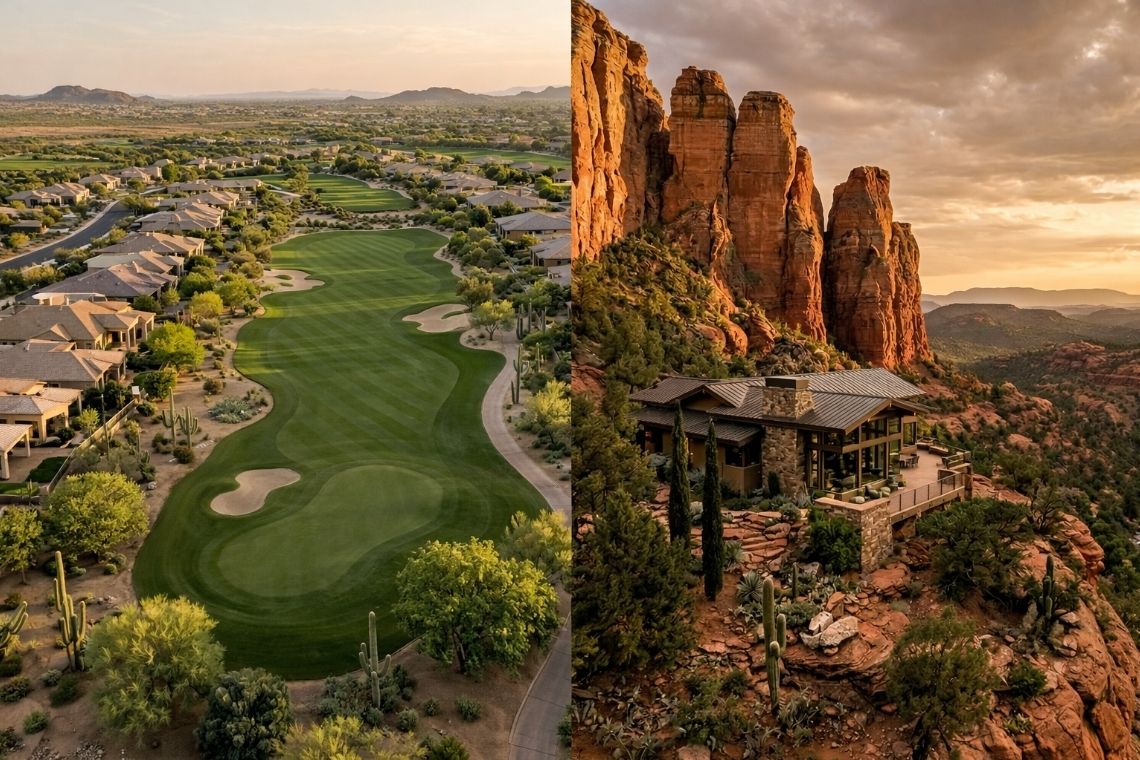
Most buyers who end up in Sedona considered Scottsdale first.
It’s a natural sequence. You’re leaving a high-cost market and researching Arizona luxury real estate. Scottsdale comes up immediately. The name recognition is strong, the infrastructure is urban, the golf courses are famous. Then you visit Sedona and the question changes.
It’s no longer “Scottsdale or somewhere else in Arizona.” It’s “which version of my life do I want?”
The Core Difference: Urban Luxury vs. Landscape Luxury
Scottsdale and Sedona are both luxury markets in Arizona, but they deliver fundamentally different things.
Scottsdale is urban luxury. It’s the desert version of a sophisticated city experience. Excellent restaurants, walkable entertainment districts, professional sports, a major airport nearby, world-class golf, shopping, and the infrastructure of a city of 250,000 people. The landscape is beautiful in its own way, but it is backdrop, not foreground.
Sedona is landscape luxury. The red rock formations are not backdrop. They are the defining feature of every experience in the city. You don’t drive past them to get somewhere. You live inside them. The town itself is small — 10,000 people — with limited commercial infrastructure. That smallness is a feature for the people who choose it and a limitation for those who need urban access.
Real Estate: Price, Product, and Value
Price Points
Both markets have broad price ranges at the luxury level. In Scottsdale, the North Scottsdale and Paradise Valley luxury market runs from approximately $1.5 million to well above $10 million for estate properties. In Sedona, the luxury market begins around $1.5 million and tops out in the $4 to $5 million range for most transactions, with exceptional estate properties occasionally above that.
What You Get Per Dollar
A $2 million budget in North Scottsdale typically buys a well-appointed home in a golf or desert community, likely part of a larger master-planned development. The same budget in Sedona’s Chapel Area buys a custom home on a private lot with direct Cathedral Rock or Bell Rock views, backing to National Forest in many cases.
The lifestyle return per dollar in Sedona is higher for buyers who specifically prioritize the natural environment. The lifestyle return per dollar in Scottsdale is higher for buyers who prioritize urban access and amenity proximity.
Long-Term Value
Both markets have appreciated consistently over the long term. Scottsdale benefits from metro Phoenix’s population growth and its position as a corporate relocation destination. Sedona benefits from permanent supply constraints, as the surrounding National Forest limits new development indefinitely. Read the current Sedona market data here.
Lifestyle: The Real Comparison
Outdoor Access
Sedona has over 200 miles of trails accessible from most residential neighborhoods. The hiking, mountain biking, and red rock landscape is world-class and immediate. Scottsdale has excellent desert hiking in the McDowell Sonoran Preserve and Pinnacle Peak area, but the experience is different in character and scale.
Climate
Sedona’s 4,500-foot elevation produces a four-season climate that differs significantly from the Phoenix metro. Scottsdale’s summer temperatures regularly exceed 110 degrees Fahrenheit, which limits outdoor activity for several months of the year. Sedona’s summer highs average in the mid-90s, with cool evenings and monsoon thunderstorms.
Community Character
Scottsdale has the community character of a sophisticated, affluent suburb. The social life is structured around golf, dining, the arts district, and professional networks.
Sedona’s community character is more unconventional. The permanent population skews toward artists, remote workers, entrepreneurs, wellness practitioners, and retirees who prioritized lifestyle above career proximity. It’s a smaller, more intentional community.
Dining, Entertainment, and Amenities
Scottsdale wins this comparison clearly. Old Town Scottsdale, the Scottsdale Quarter, and the broader Phoenix metro provide dining, entertainment, and cultural options that Sedona cannot match at its size. Sedona has excellent dining and a genuine arts scene, but it is a small town and the range of options reflects that.
Who Should Choose Scottsdale, and Who Should Choose Sedona
Choose Scottsdale if proximity to a major airport, walkable urban amenities, professional networking, and a larger metro social infrastructure are important to how you want to live.
Choose Sedona if the natural landscape is central to your life vision, if you want a smaller, more intentional community, if you value trail access and outdoor living above urban convenience, and if the red rock environment specifically speaks to something in how you want to spend your time.
Many buyers who ask “Scottsdale or Sedona?” have already answered the question before they visit both. They just needed to see the options next to each other to confirm it.
Frequently Asked Questions: Sedona vs. Scottsdale Real Estate
Is Sedona or Scottsdale more expensive for real estate?
Both markets have broad luxury price ranges. North Scottsdale and Paradise Valley extend to higher absolute prices than Sedona at the very top end. At comparable price points between $1.5 million and $3 million, Sedona typically delivers more land, more natural setting, and more privacy. Scottsdale delivers more square footage, newer large-scale construction, and proximity to urban infrastructure.
Is Sedona closer to Phoenix or Flagstaff?
Sedona, Arizona is approximately 2 hours north of Phoenix Sky Harbor Airport and approximately 45 minutes south of Flagstaff. Scottsdale is within the Phoenix metro, approximately 20 to 30 minutes from the airport. For buyers who travel frequently, Scottsdale’s airport proximity is a meaningful practical advantage.
Which has better weather: Sedona or Scottsdale?
Sedona’s 4,500-foot elevation produces meaningfully cooler summers than Scottsdale’s desert floor. Scottsdale summer highs frequently exceed 110 degrees, limiting outdoor activity for several months. Sedona’s summer highs average in the mid-90s. Winter in both markets is mild, with Sedona occasionally receiving snow that rarely occurs in Scottsdale.
Can I live in Sedona and commute to Scottsdale or Phoenix?
A daily commute from Sedona to Scottsdale or Phoenix is approximately 2 hours each way, making a daily commute impractical for most people. Sedona works well for buyers who work remotely, are retired, or commute infrequently. Buyers with regular in-person work requirements in the Phoenix metro will generally find Scottsdale more practical.
Which market has better long-term appreciation potential?
Both Sedona, Arizona and Scottsdale have strong long-term appreciation fundamentals. Sedona’s permanent supply constraints from surrounding National Forest create structural scarcity that supports value independently of broader market cycles. Scottsdale benefits from metro Phoenix population growth and corporate relocation demand. Both have outperformed national averages over the long term.
What if I want both — Sedona lifestyle and Scottsdale access?
Some buyers purchase a primary residence in Scottsdale for career and family reasons while buying a Sedona second home for weekends and extended stays. The two-hour drive between markets makes this combination more practical than it would be in markets further apart. Read the full Sedona second home guide here.
If you’ve been researching both markets and want an honest perspective from someone who works exclusively in Sedona, reach out to Angelo Davis, REALTOR® at RE/MAX Sedona, at (928) 274-9114. He’ll tell you whether Sedona is the right answer for your situation, and if it is, what that looks like specifically.
