Most visitors come to Sedona for rocks that are millions of years old. Far fewer go looking for the walls that human hands built into them eight centuries ago.
West of town, tucked under the Red Cliffs, two sites hold that older story. Palatki and Honanki are where Sedona, Arizona stops being only scenery and becomes a place people have called home for a very long time.
What Palatki and Honanki Actually Are
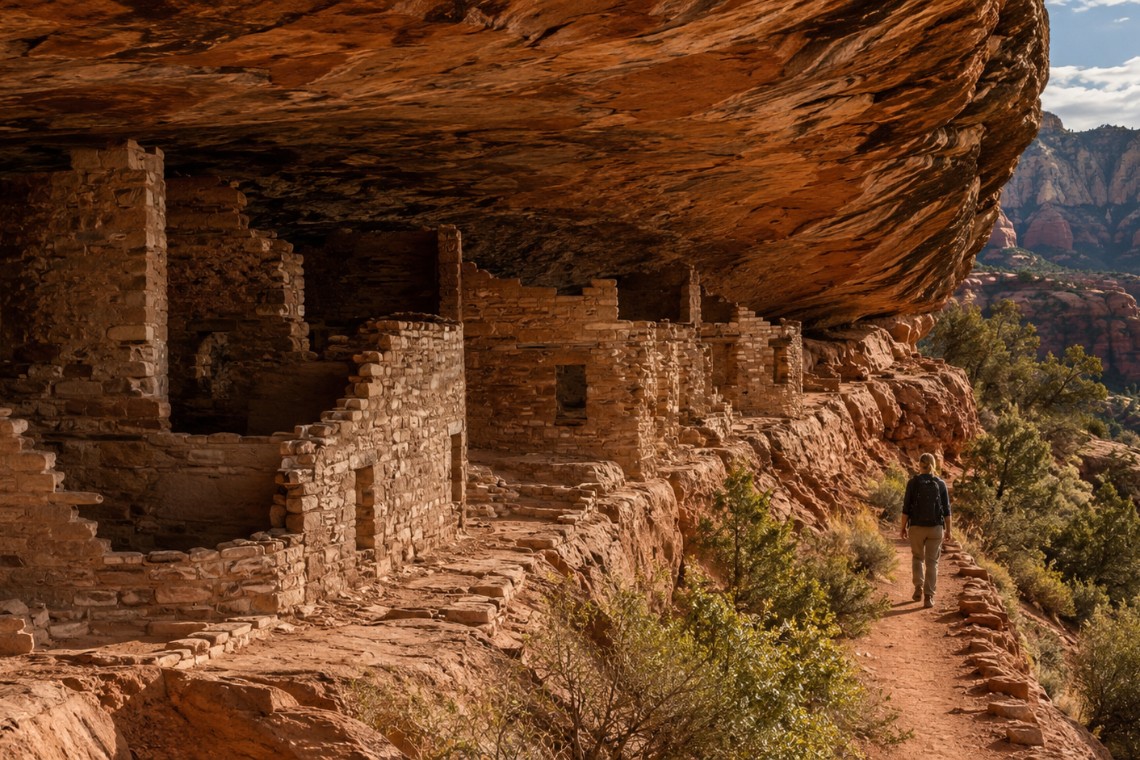
Palatki and Honanki are ancient cliff dwellings and rock art sites built by the Sinagua people roughly 700 to 900 years ago, set into the Red Cliffs in the Coconino National Forest west of Sedona, Arizona. Palatki also holds rock art panels that span thousands of years of use.
The Sinagua built stone rooms beneath natural alcoves, using the cliff itself as a roof and back wall. What remains is weathered but unmistakable, a row of dwellings pressed into the rock.
Palatki pairs its dwellings with a separate rock art site, where pictographs and petroglyphs cover the stone. Some of those images are far older than the buildings, left by people who passed through long before the Sinagua arrived.
Honanki, a few miles deeper into the forest, is larger. It sees fewer visitors, which gives it a quieter, more solitary feeling.
How to Visit Palatki and Honanki
Visiting Palatki requires a reservation, since the site limits how many people can be on the trails at once, while Honanki does not require one but sits at the end of a rougher forest road. Both are reached from Boynton Pass Road in West Sedona and both require a Red Rock Pass.
Palatki is the more managed experience. Volunteer docents are usually on hand to interpret the dwellings and the rock art, and the short trails are well maintained.
Honanki rewards a little more effort and a higher-clearance vehicle. The forest road, FR 525, is graded dirt that turns rough and slow, especially after rain.
Plan to call ahead for a Palatki reservation rather than showing up. Turning people away is common on busy days, and the drive is too long to gamble on.
Why These Sites Matter More Than the Average Stop
Palatki and Honanki matter because they connect the Sedona landscape to a continuous human story, not just a geologic one. Standing inside a Sinagua alcove changes how the red rocks feel for good.
The same cliffs, springs, and canyons that draw people today drew people centuries ago for the same reasons. Water, shelter, and a setting that is hard to leave.
That continuity is easy to forget when Sedona is sold as a backdrop. These sites are the reminder that this has always been a place worth choosing.
For hikers, they also pair naturally with the trails nearby, including Boynton Canyon, which holds its own ancient cliff dwelling high on the canyon wall.
What This Means if You Are Moving to Sedona
Living near sites like Palatki gives a deeper texture to a move that can otherwise feel purely aspirational. You are not just buying a view. You are joining a very long line of people who looked at this land and stayed.
For buyers drawn to the western edge of Sedona, Arizona, the homes near Boynton Pass Road sit closest to this history. The West Sedona area trades polish for proximity to exactly this kind of country.
Angelo Davis, REALTOR® at RE/MAX Sedona, often points relocating clients toward these sites early. Once you understand how long people have valued this place, the decision to put down roots here makes a different kind of sense.
Frequently Asked Questions
Do you need a reservation to visit Palatki in Sedona?
Yes, a reservation is required to visit the Palatki Heritage Site because the number of visitors on the trails is limited each day. Honanki does not require a reservation, but it sits at the end of a rougher forest road.
How old are the Palatki and Honanki cliff dwellings?
The cliff dwellings at Palatki and Honanki were built by the Sinagua people roughly 700 to 900 years ago. Some of the rock art at Palatki is much older, left by earlier peoples over thousands of years.
Where are Palatki and Honanki located near Sedona?
Palatki and Honanki are in the Coconino National Forest west of Sedona, Arizona, reached from Boynton Pass Road onto Forest Road 525. Both sites require a Red Rock Pass to visit.
Can you drive a regular car to Palatki and Honanki?
Most vehicles can reach Palatki on the graded forest road in dry conditions, though the drive is slow and bumpy. Honanki is farther along a rougher road, so a higher-clearance vehicle is strongly recommended.
Are Palatki and Honanki worth visiting?
Yes, Palatki and Honanki are among the most meaningful stops in the Sedona area because they connect the landscape to centuries of human history. Visitors consistently find the dwellings and rock art more moving than they expected.
A thousand years of people have chosen this landscape, and the reasons have not changed much. If a deeper kind of Sedona is pulling at you, let’s talk before your next visit.
