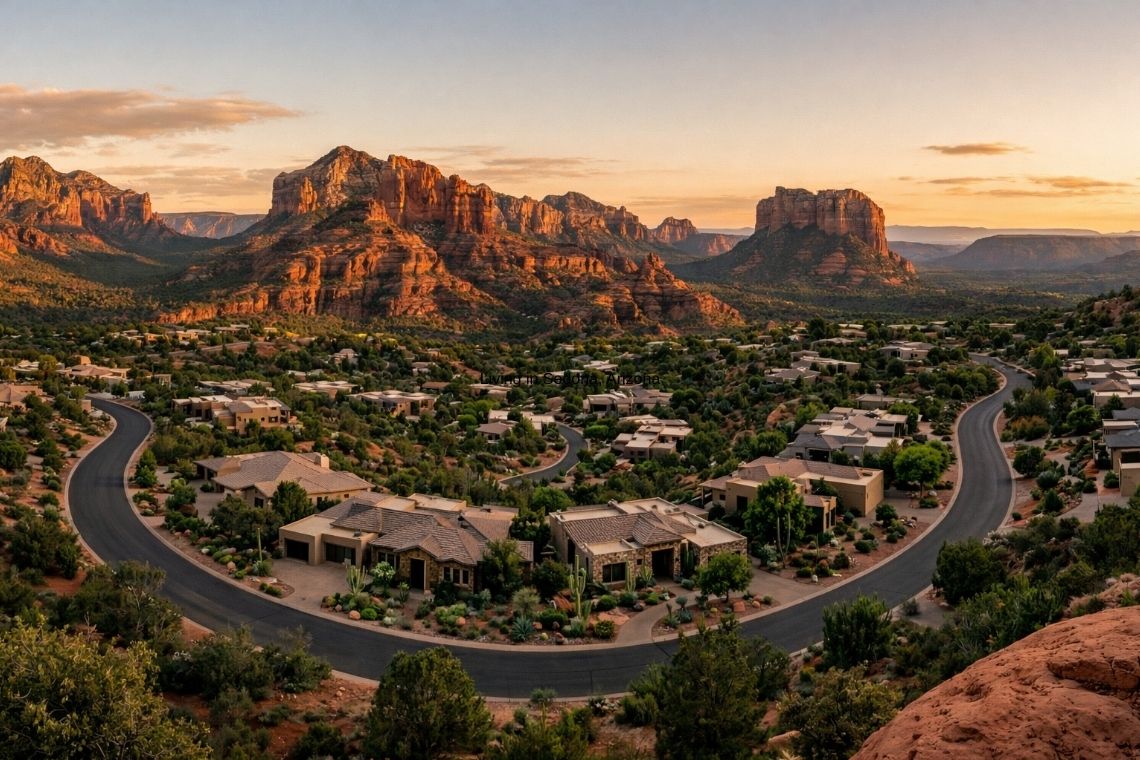
People research Sedona, Arizona for years before they buy here.
They bookmark articles. They save Zillow searches. They drive through on vacation and spend three days asking the same question: could we actually do this? The views are obvious. What takes longer to understand is what daily life actually looks like once the scenery becomes your backyard.
Here’s the honest picture.
Climate: What You’re Actually Signing Up For
Sedona, Arizona sits at 4,500 feet elevation, which separates it completely from the Phoenix heat narrative that defines most people’s mental model of Arizona.
Summers are warm, not extreme. July and August daytime highs average in the mid-90s, with evenings cooling into the 60s. The monsoon season, typically July through September, brings afternoon thunderstorms that are among the most dramatic weather events in the Southwest. Lightning over the red rocks is something you see once and remember permanently.
Winters are mild and brief. Daytime highs in December and January typically run in the mid-50s. Snow falls occasionally, sometimes spectacularly, on the red formations. It rarely stays. Spring and fall are extraordinary, with daytime temperatures in the 65 to 80 degree range and skies that most places in America simply don’t have.
Sedona gets approximately 300 sunny days per year. For buyers coming from the Pacific Northwest, the Midwest, or the Northeast, this number changes how they think about their future home.
The Outdoor Life: What’s Actually Available
Sedona, Arizona has over 200 miles of maintained trails within a short distance of most residential neighborhoods. This is not a figure that requires a drive to a trailhead. Many West Sedona and Chapel Area homes have direct access to the trail system from the street.
Trails and Hiking
The range of difficulty is genuine. Cathedral Rock, Bell Rock, and Devil’s Bridge are among the most photographed trails in the country and are accessible to most fitness levels. Vultee Arch, Wilson Mountain, and the West Fork of Oak Creek offer longer, more demanding routes in extraordinary terrain. Boynton Canyon and Secret Canyon take hikers into designated Wilderness areas that feel genuinely remote despite their proximity to town.
Mountain Biking
Sedona has a globally recognized mountain biking community. The Sedona Bike Park and the technical trail networks around West Sedona attract riders from across the world. The combination of terrain variety and year-round rideable conditions makes it one of the premier mountain biking destinations in North America.
Water and Other Activities
Oak Creek runs year-round through the city and through Oak Creek Canyon to the north. Slide Rock State Park, a natural red rock water slide fed by the creek, is one of the most-visited sites in Arizona. Fishing, swimming, and creek access are available at multiple points throughout the corridor.
Schools in Sedona, Arizona
Sedona is served by the Sedona-Oak Creek Unified School District, which operates a small number of schools serving students from pre-kindergarten through 12th grade.
Public Schools
Sedona Red Rock High School consistently receives strong ratings and serves students from across the Sedona area. The smaller enrollment relative to Phoenix metro schools means students have access to teachers and extracurricular programs in ways that larger suburban districts often cannot provide.
Private and Alternative Options
Sedona has a small but active community of private, charter, and alternative education options. Waldorf-influenced approaches and nature-based programs have found a natural home in a community that strongly values the outdoor and artistic environment. Several families in Sedona choose homeschooling, supported by an active statewide homeschool community in Arizona.
Higher Education
Yavapai College has a campus in Sedona offering community college coursework. Northern Arizona University in Flagstaff, approximately 45 minutes north, provides access to a full four-year university environment.
Healthcare in Sedona, Arizona
Healthcare is one of the most important practical considerations for buyers relocating to Sedona, particularly retirees and those with ongoing medical needs.
Local Facilities
Verde Valley Medical Center, operated by Northern Arizona Healthcare, is located in Cottonwood, approximately 20 minutes from most Sedona neighborhoods. It provides emergency services, inpatient care, surgical services, and a range of specialty clinics. Sedona itself has a small hospital campus and multiple physician practices, urgent care facilities, and specialty providers.
Flagstaff and Phoenix
For specialized care and major procedures, Flagstaff Medical Center is approximately 45 minutes north. The Phoenix metropolitan area, approximately 2 hours south, has major hospital systems and every medical specialty.
The honest picture for healthcare is this: Sedona is well-served for primary care and urgent needs, and adequately served for most specialty care through the broader Northern Arizona network. For complex oncology, cardiac surgery, or highly specialized procedures, Phoenix is the resource.
Arts, Culture, and Community
Sedona, Arizona has one of the highest concentrations of working artists per capita in the United States. The Tlaquepaque Arts and Shopping Village, the Sedona Arts Center, and dozens of independent galleries represent a genuine arts community, not a tourism simulation.
The Sedona International Film Festival draws audiences from across the country each February. The Sedona Arts Festival in October is one of the most well-attended outdoor arts events in the Southwest. Music, theater, and cultural programming run year-round.
The community itself is unusually international and educated for a city of its size. The decision to live in Sedona is a deliberate one, and the people who make it tend to be interesting. That’s one of the less quantifiable but consistently noted observations from people who move here.
Frequently Asked Questions: Living in Sedona, Arizona
What is the population of Sedona, Arizona?
Sedona, Arizona has a permanent residential population of approximately 10,000 people, though the city sees several million visitors per year. The small permanent population creates a genuine small-town community character that coexists with a resort economy. Most full-time residents know each other to varying degrees, and community involvement runs deep.
Is Sedona a good place to retire?
Sedona, Arizona is one of the most popular retirement destinations in the American Southwest and consistently appears on national retirement destination rankings. The combination of mild climate, extraordinary landscape, active outdoor lifestyle, arts community, and relatively low property taxes makes it exceptionally well-suited for active retirees. Read the full Sedona cost of living guide here.
What is the cost of living in Sedona, Arizona?
Sedona carries a resort town cost structure for goods and services. Groceries, dining, and everyday expenses run higher than Phoenix or Flagstaff averages. The significant financial offsets are lower property taxes, lower state income taxes than most origin states, and lower real estate costs per square foot compared to comparable lifestyle markets. Most buyers who have modeled the full financial picture find Sedona compares favorably to their origin market on total annual cost of ownership.
What is the weather like in Sedona, Arizona?
Sedona has four distinct seasons at its 4,500-foot elevation. Summers are warm with monsoon thunderstorms in July and August. Winters are mild with occasional snow on the formations. Spring and fall offer the most temperate conditions, with daytime temperatures in the 65 to 80 degree range. Sedona receives approximately 300 sunny days per year. It is not a hot desert climate in the way Phoenix is.
Are there good restaurants in Sedona?
Sedona has an unusually strong restaurant scene for a city of its size. The combination of a well-traveled, discerning local population and millions of annual visitors has produced a dining culture that ranges from casual creekside spots to serious fine dining. Uptown Sedona and Tlaquepaque concentrate much of the dining activity, with additional options throughout West Sedona and the Village of Oak Creek.
What do people do for work in Sedona?
Sedona’s economy is primarily driven by tourism, hospitality, the arts, wellness, and real estate. A growing segment of the population works remotely, drawn to Sedona’s lifestyle while maintaining careers in other industries. The city is not a corporate employment center, and buyers who depend on local employment should research the job market in their specific field before committing to a full-time relocation. Read about working remotely from Sedona here.
Pass this along to someone who’s been asking the same questions. Or reach out to Angelo Davis, REALTOR® at RE/MAX Sedona, at (928) 274-9114 to talk through what daily life in Sedona actually looks like.
