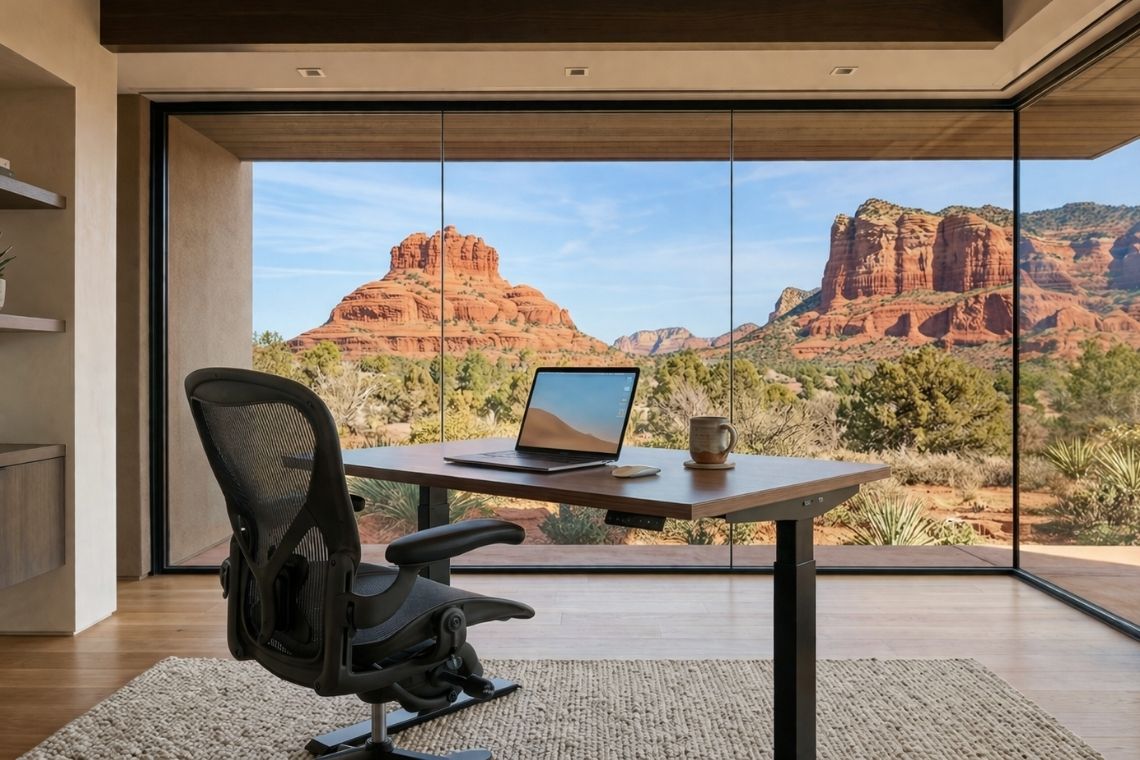
The home office upgrade most remote workers are imagining is a better desk or a faster monitor.
The actual upgrade is a window with Cathedral Rock in it.
If you can work from anywhere, the question of where to work is a real estate question. And an increasing number of people who figured that out in the past few years landed on Sedona, Arizona. Not as a vacation. As a permanent choice.
Why Remote Workers Choose Sedona
The reasons are practical and emotional in roughly equal measure.
On the practical side: reliable broadband is available throughout most of Sedona’s residential neighborhoods. The time zone is Mountain Standard Time, which aligns well with both coasts without the extreme early morning calls that Pacific Time creates for East Coast-heavy teams. Phoenix Sky Harbor is two hours south for when in-person meetings are unavoidable.
On the emotional side: waking up in Sedona, Arizona and hiking for an hour before your first call is a qualitatively different way to start the workday than commuting through traffic. The combination of physical landscape and pace of life produces something that most remote workers who’ve tried it describe as a permanent upgrade to their quality of work and quality of thought.
The Practical Reality of Working Remotely in Sedona
Internet Connectivity
Most Sedona residential neighborhoods have access to fiber or high-speed cable broadband. Cox Communications is the primary cable provider. Starlink satellite internet is available as a backup or primary option in areas where terrestrial service is less reliable.
Speed and reliability vary by neighborhood and specific address. Before purchasing a property with remote work as a primary use case, verify the actual internet service available at that address. A site visit with a speed test and a conversation with neighbors about service quality is worth the extra step.
Cell Service
Sedona’s canyon geography creates cell service variation that surprises people accustomed to urban coverage. Most of the city has adequate coverage from major carriers. Some areas, particularly in Oak Creek Canyon and certain canyon-facing properties, have limited coverage. If cellular service is important to your work setup, test it on the property before closing.
The Time Zone Question
Arizona does not observe daylight saving time, which creates a unique time zone situation that changes seasonally relative to other states. During standard time, Arizona is on Mountain Standard Time. During daylight saving time, when most of the country springs forward, Arizona stays put, effectively moving to Pacific Time relative to the East Coast. This matters for remote workers whose meeting schedules span time zones.
What Remote Workers Look for in a Sedona Home
Remote workers who buy in Sedona, Arizona have a distinct property profile compared to retirees or second home buyers.
A dedicated home office or a room that converts cleanly into one is near the top of most remote worker wish lists. Natural light and views from the workspace are important, because the reason you moved here was partly to have this environment while you work.
Acoustic separation matters more than it does for other buyer types. A home where the work area can be closed off from household activity during calls and meetings is a meaningful functional requirement.
Outdoor spaces adjacent to the home also matter. The ability to step outside for a five-minute break into a genuinely extraordinary natural environment is a feature that remote workers in Sedona name consistently as central to their experience.
The Financial Picture for Remote Workers Relocating to Sedona
For remote workers earning income from employers or clients in other states, the financial case for Sedona, Arizona is often compelling.
If you’re earning a San Francisco or New York salary while living in Sedona, you’re capturing the income of a high-cost market while paying the property taxes, state income taxes, and cost of living of a significantly lower-cost environment.
Arizona’s income tax rates are substantially lower than those of California, New York, and most other states where tech and finance workers are concentrated. Property taxes in Sedona run approximately 0.43% to 0.49% of assessed value, well below national averages. Read the full tax comparison here.
Domicile and Tax Residency Considerations
Moving to Sedona, Arizona as a remote worker involves tax residency decisions that deserve careful attention.
Establishing Arizona as your domicile state typically involves spending the majority of the year there, registering your vehicle in Arizona, updating your voter registration, and conducting your primary business and financial activities from your Arizona address.
California has a history of asserting income tax jurisdiction over former residents who maintain significant connections to the state. Remote workers leaving California for Sedona should work with a CPA and potentially a tax attorney to document the move correctly and sever California tax residency cleanly. Angelo Davis, REALTOR® at RE/MAX Sedona, can refer buyers to CPAs who specialize in domicile transitions for high-income remote workers.
Frequently Asked Questions: Working Remotely from Sedona, Arizona
Is the internet good enough in Sedona for remote work?
Most Sedona residential neighborhoods have access to high-speed broadband through Cox Communications or similar providers, with Starlink available as a backup. Internet quality varies by address. Most remote workers in Sedona report internet quality as adequate to excellent for standard remote work requirements. Before purchasing for remote work, verify actual service availability at the specific address.
What is the time zone in Sedona, Arizona?
Sedona, Arizona operates on Mountain Standard Time year-round. Arizona does not observe daylight saving time. During daylight saving months, Sedona effectively operates on Pacific Time relative to East Coast hours. Remote workers on East Coast schedules should factor earlier morning calls into their planning during those months.
Can I save money on taxes by working remotely from Sedona?
Remote workers who establish Arizona domicile will generally pay lower state income taxes than in most high-income states. Arizona’s flat 2.5% rate is significantly more favorable than California, New York, Illinois, and most other states where tech and finance workers are concentrated. A CPA familiar with multi-state tax issues is essential for modeling your specific situation. Read the full Sedona cost of living guide here.
Is Sedona a good place for remote workers with families?
Sedona is a strong environment for remote workers with families who value outdoor lifestyle, community, and education quality over urban density. The Sedona-Oak Creek Unified School District provides quality K-12 education in a small school environment. The outdoor recreation available to families is exceptional. The tradeoff is a smaller peer community for children than major metros provide.
What kind of homes do remote workers typically buy in Sedona?
Remote workers in Sedona prioritize a dedicated home office or convertible space, strong natural light and outdoor views from the work area, outdoor living spaces for breaks, and broadband-confirmed connectivity. They often choose single-level homes in West Sedona for practical livability, or Chapel Area and Village of Oak Creek properties for the view environment that motivated the move.
Are there coworking spaces in Sedona?
Sedona has a small number of coworking and shared professional spaces, primarily in West Sedona. The creative and entrepreneurial character of Sedona’s permanent population makes informal professional networking naturally available through the arts community, local business associations, and the broader network of people who chose Sedona deliberately.
If you’re a remote worker who’s been thinking about making Sedona, Arizona your base, reach out to Angelo Davis at (928) 274-9114 before your next visit. A conversation about what remote workers look for in this market changes what you see when you walk through properties.
