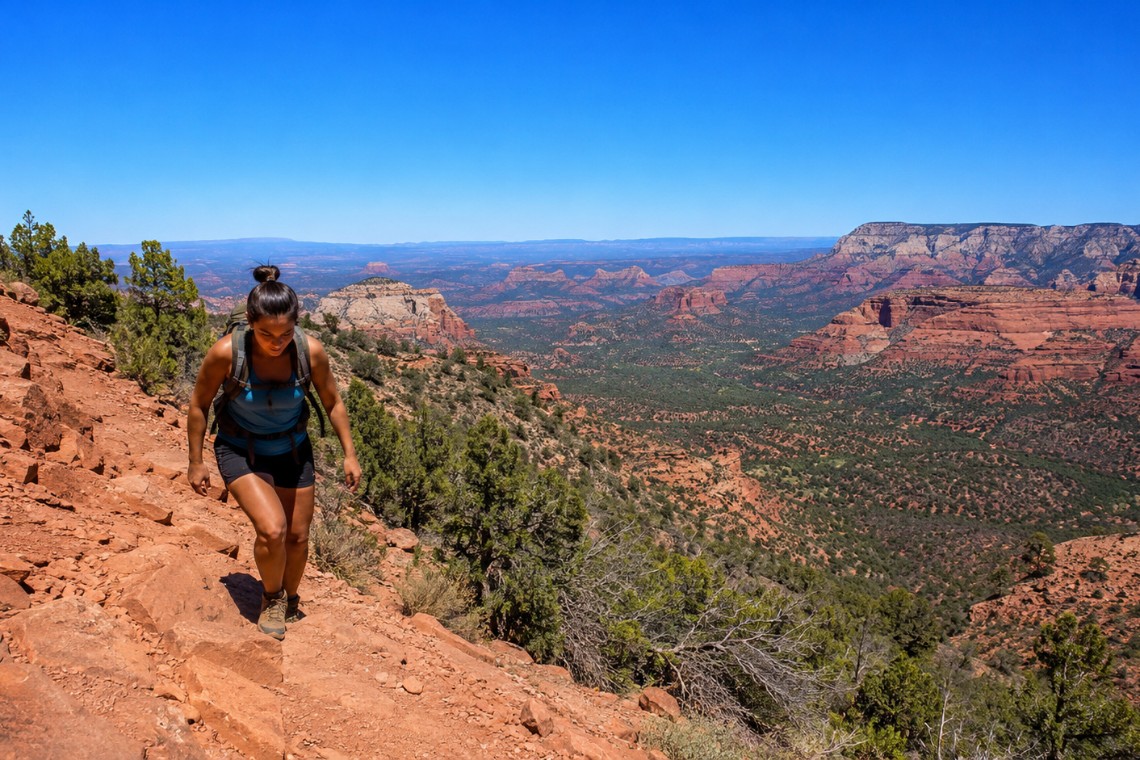
There is a moment on Bear Mountain, usually at the second false summit, when most hikers stop and quietly recalculate their afternoon. The top is still not in sight.
That moment is the trail’s reputation in a single breath. Bear Mountain does not hide what it asks of you, and that honesty is exactly why a certain kind of hiker keeps coming back to it.
Why Bear Mountain Is Sedona’s Toughest Day Hike
Bear Mountain is widely considered the hardest day hike in Sedona, Arizona, covering about 5 miles round trip with roughly 2,000 feet of elevation gain over steep, rocky terrain. The climb comes in punishing waves rather than one steady grade.
The difficulty is not the distance. It is the way the trail keeps rising, leveling, and rising again across a series of false summits that each look like the top until you crest them.
You climb hard, reach a ridge, and see the real summit still waiting beyond a saddle. Then you do it again.
For experienced hikers that structure is the draw. Bear Mountain is a genuine effort in a town where many famous trails are short, and finishing it feels earned in a way a quick mesa walk never will.
What You See From the Bear Mountain Summit
From the upper reaches of Bear Mountain the view opens across the entire west side of Sedona, with the San Francisco Peaks above Flagstaff visible on clear days. The higher you climb, the more the red rock country flattens into a map below you.
You look down on Doe Mountain, the mesa that felt tall an hour earlier. You trace Boynton Pass Road, the canyons, and the wall of cliffs that hem in West Sedona.
This is the payoff that miles and elevation buy. Few overlooks in West Sedona give you this much country at once, and almost none of them require this little company.
How to Prepare for the Bear Mountain Hike
To hike Bear Mountain safely, carry at least three liters of water per person, start at first light, and treat full sun and steep slickrock as the real hazards. There is almost no shade on the route.
This is not a casual hike, and it is not the trail to attempt in July at noon. Summer hikers should be off the mountain before the heat builds, which means a pre-dawn start.
Sturdy shoes with real tread are not optional. Long stretches cross open slickrock and loose rock where smooth soles turn the descent into a slow, careful problem.
The trailhead is shared with Doe Mountain off Boynton Pass Road, and a Red Rock Pass is required to park. The contrast is almost comic: two trails, one lot, wildly different days.
Who Should Hike Bear Mountain and Who Should Skip It
Bear Mountain rewards fit, experienced hikers and frustrates almost everyone else, so honesty with yourself is the smartest gear you can bring. If you want big views without the suffering, Doe Mountain or Boynton Canyon will serve you far better.
Hikers with knee trouble should think hard about the descent. Coming down 2,000 feet of rocky grade is its own challenge, often harder on the body than the climb.
For trained hikers, though, Bear Mountain is one of the most satisfying half-days in the region. It is the rare Sedona, Arizona trail that feels like a mountain, not a viewpoint.
What This Means if You Are Moving to Sedona
A trail like Bear Mountain says something about what living in West Sedona actually offers. Serious terrain sits minutes from neighborhoods where people run errands and walk dogs.
For active buyers relocating to Sedona, Arizona, that proximity is often the deciding factor over a flatter, more polished suburb elsewhere. The mountains are not a weekend destination here. They are the backyard.
Angelo Davis, REALTOR® at RE/MAX Sedona, hears the same thing from these buyers again and again. They are not moving for a house. They are moving for the kind of morning that ends at a trailhead.
Frequently Asked Questions
How hard is the Bear Mountain hike in Sedona?
Bear Mountain is rated strenuous and is widely called the hardest day hike in Sedona, with about 5 miles round trip and roughly 2,000 feet of elevation gain. The series of false summits makes it feel longer and tougher than the mileage suggests.
How long does it take to hike Bear Mountain?
Most hikers need three to five hours to complete Bear Mountain, depending on fitness, heat, and time spent at the top. Starting early is important because the trail offers almost no shade once the sun is up.
Is Bear Mountain safe to hike in summer?
Bear Mountain can be hiked in summer only with a pre-dawn start, plenty of water, and a plan to be off the exposed slopes before midday heat. Attempting it in full afternoon sun in Sedona, Arizona is genuinely dangerous.
Where does the Bear Mountain trail start?
The Bear Mountain trail starts in West Sedona along Boynton Pass Road, sharing a trailhead and parking area with Doe Mountain. A Red Rock Pass is required to park, and spaces fill early on weekends.
Is Bear Mountain good for beginners?
Bear Mountain is not recommended for beginners because of its steep grades, exposure, and demanding descent. Newer hikers will enjoy Doe Mountain or a flat canyon trail far more and finish with energy to spare.
The best Sedona trails rarely make the tourist lists, and neither do the best moments to make a move. One story a month, no noise.
