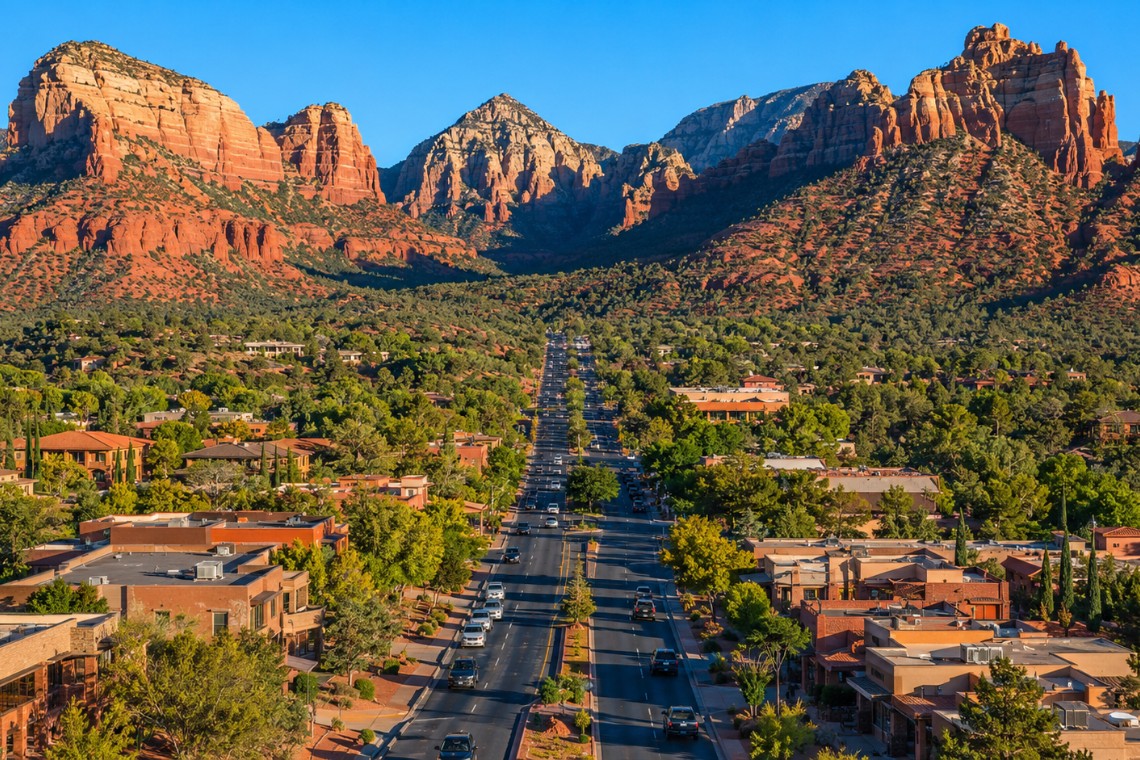
Uptown Sedona is the original town. The name is descriptive in the oldest sense: it refers to the original townsite of Sedona, Arizona at the mouth of Oak Creek Canyon, the commercial and community center that existed before the surrounding residential neighborhoods were developed and named. The highway that runs through it, 89A, is lined with shops, restaurants, hotels, pink jeep tour operators, and art galleries in a density that no other Sedona neighborhood approaches.
Buyers who choose Uptown do so knowing what they are getting. The ones who choose it and are later surprised by what they find are the ones who did not understand what the address actually means on a busy Saturday in April.
Where Uptown Sedona Is and How It Is Defined
Uptown Sedona is the neighborhood along Highway 89A east of the Y intersection, extending north toward the mouth of Oak Creek Canyon where the highway begins its climb through the canyon gorge. The commercial core runs approximately 1 mile along 89A. The residential areas sit on the streets that climb away from the highway on both sides, some ascending toward the rim formation terrain above town, others following the creek corridor east.
The formation views from Uptown Sedona, Arizona are distinct from the rest of the market. Snoopy Rock (also called Peanuts Rock) is the dominant formation visible from most Uptown addresses, with Steamboat Rock and Wilson Mountain defining the northern horizon above the canyon entrance. Capitol Butte is visible to the west. Cathedral Rock is generally not visible from Uptown addresses, which is one of the key view distinctions between Uptown and the Chapel Area or West Sedona.
The Uptown Trade-Off: Walkability vs. Tourist Density
Uptown Sedona is the only neighborhood in Sedona, Arizona where a resident can walk out the front door and be at a restaurant, gallery, coffee shop, or trailhead within a few minutes without a car. That walkability is the primary draw and the consistent reason buyers give for choosing this address specifically.
The trade-off is real and worth understanding before you buy. The streets close to Highway 89A experience traffic, parking pressure, and tourist density at a level that none of the outlying Sedona neighborhoods share. During spring and fall peak season, weekend afternoons on 89A through Uptown are loud, congested, and busy in the way that any successful tourist commercial corridor is loud, congested, and busy.
Properties set back from the highway, particularly those on streets that climb away from 89A toward the formation terrain on the north side of town, or those on the Jordan Road corridor to the west, have a quieter residential character while still retaining the proximity to the commercial core that makes Uptown distinctive. The specific street matters enormously in Uptown Sedona. Two properties a quarter mile apart can have dramatically different daily experiences.
Formations, Views, and What Uptown Sedona Delivers Visually
The view character from Uptown Sedona, Arizona is one of the most underappreciated aspects of the address. Buyers who enter Sedona from Phoenix via Highway 179 see the Cathedral Rock and Bell Rock formations that define the Chapel Area and Village of Oak Creek identity. Those formations are spectacular and heavily photographed. They are not what you see from Uptown.
What you see from Uptown Sedona is the canyon. The view north up Highway 89A as it enters Oak Creek Canyon, with the sandstone walls rising on both sides and the road narrowing into the gorge, is one of the great road views in Arizona. Residents who make this drive daily to reach Grasshopper Point, Slide Rock, or West Fork describe it as non-negotiable. You do not take it for granted.
Properties on the north-facing streets above Uptown, particularly those at elevation on the hillsides that back up toward the canyon rim, have views that are distinct from anywhere else in the Sedona market. The canyon walls visible from these positions, the specific quality of the light on Snoopy Rock in afternoon, and the sound of Oak Creek audible from properties close enough to the creek corridor are sensory details that photographs do not capture adequately.
Housing Types and Price Range in Uptown Sedona
Uptown Sedona in Sedona, Arizona has one of the wider price ranges of any single neighborhood in the market. Properties close to Highway 89A at lower elevation, particularly older mid-century residences that have not been substantially updated, represent some of the most affordable residential addresses in Sedona. Properties at elevation on the hillsides above town with formation views and updated construction represent some of the most distinctive.
Home styles across the neighborhood span from small 1950s and 1960s ranch residences built when Sedona was a small agricultural and arts community, to 1980s and 1990s updates, to contemporary construction on premium view lots. The neighborhood has seen less new development than West Sedona because the available land is more constrained by the formation terrain on the north and the highway corridor on the south. This constraint is part of what preserves the neighborhood’s character.
Entry-level Uptown properties start below $500,000 in the current market. Premium hillside positions with unobstructed canyon and formation views push above $1.5 million. The spread reflects the genuine range of what the Uptown address delivers depending on exactly where within it you are located.
Trail Access from Uptown Sedona
The trail access from Uptown Sedona, Arizona is different from the formation trail networks that define the Chapel Area and West Sedona. The primary trails accessible within reasonable proximity of Uptown are:
Wilson Mountain trail, a significant hike that climbs from the Midgley Bridge area on Highway 89A to the top of the Wilson Mountain massif above the canyon. It is a genuine full-day commitment and one of the best high-viewpoint hikes in the Sedona area.
Schnebly Hill Road, which leaves Highway 89A near the base of the Schnebly Hill formation and provides access to a network of formation trails above the canyon. The road itself is 4WD territory for vehicles, but hikers can walk it or access specific trailheads from it.
Marg’s Draw trail, a less-trafficked West Sedona connector trail accessible from near the Y intersection that provides formation access without the crowds of the more visible trailheads.
The walkable access to Grasshopper Point and the south entrance to Oak Creek Canyon, approximately 1.5 miles north on 89A from the Uptown commercial core, is a specific daily-use trail and swimming access point that no other Sedona neighborhood provides on foot.
Who Buys in Uptown Sedona and Why
The buyer profile that consistently gravitates toward Uptown Sedona, Arizona is distinct from the West Sedona buyer seeking trail access and quiet, and distinct from the Chapel Area buyer seeking formation intimacy. Uptown buyers prioritize being in the middle of things. They value morning coffee at a gallery cafe, evening meals without a car, the ability to walk to Oak Creek for a swim. They are comfortable with the tourist energy of the commercial corridor because it is the price of admission for what the address delivers.
Second-home buyers are well-represented in Uptown Sedona because the walkability makes partial-time occupancy practical in a way that more isolated Sedona addresses are not. A part-time resident who can walk to restaurants and the canyon entrance gets more from their visits than one who needs a car for every outing.
Primary residence buyers who choose Uptown tend to have specifically identified walkability and the canyon orientation as non-negotiable elements. Angelo Davis, REALTOR® at RE/MAX Sedona, has worked with Uptown buyers who arrived having looked at the full Sedona market and came back to Uptown specifically. The neighborhood is not the default; it is a deliberate choice.
Frequently Asked Questions
What is Uptown Sedona, Arizona?
Uptown Sedona is the original townsite of Sedona, Arizona, located along Highway 89A east of the Y intersection at the mouth of Oak Creek Canyon. It is Sedona’s most walkable neighborhood, with the highest density of restaurants, galleries, shops, and tour operators. The area is defined by views of Snoopy Rock, Wilson Mountain, and the Oak Creek Canyon entrance rather than the Cathedral Rock and Bell Rock views that define other Sedona neighborhoods.
What are home prices in Uptown Sedona?
Uptown Sedona home prices in Sedona, Arizona range broadly. Entry-level properties near the highway in lower-elevation positions start below $500,000. Premium hillside properties with unobstructed formation and canyon views push above $1.5 million. The specific street and elevation position drive price more in Uptown than in most other Sedona neighborhoods.
Is Uptown Sedona a good place to live?
Uptown Sedona is a good place to live for buyers who specifically value walkability to dining, galleries, and Oak Creek Canyon access, and who are comfortable with the tourist traffic character of the commercial corridor. It is less well-suited for buyers who prioritize quiet, space, and distance from visitor activity. The match between buyer profile and the address is tighter in Uptown than in most Sedona neighborhoods.
Is Uptown Sedona walkable?
Yes. Uptown Sedona is the most walkable neighborhood in Sedona, Arizona. Residents can access multiple restaurants, galleries, and shops without a car. Tlaquepaque Arts and Shopping Village is a short walk south. Grasshopper Point day use area and the south entrance to Oak Creek Canyon are approximately 1.5 miles north on Highway 89A.
What trails are accessible from Uptown Sedona?
Uptown Sedona, Arizona provides access to Wilson Mountain trail from the Midgley Bridge area, Schnebly Hill Road formation trails, and Marg’s Draw trail near the Y intersection. Grasshopper Point swimming access is a walkable 1.5 miles north. The West Sedona and Chapel Area formation trail networks require a 10 to 15 minute drive.
How does Uptown Sedona compare to West Sedona?
Uptown Sedona and West Sedona in Arizona serve different buyer priorities. Uptown offers walkable access to dining, galleries, and the canyon entrance at the cost of higher tourist density and traffic. West Sedona offers quieter residential character, the Dry Creek Basin trail network, and more space at the cost of requiring a car for most commercial access. Neither is objectively better; they serve different lifestyles.
—
If you are evaluating Uptown Sedona against the other five Sedona neighborhoods and want a frank comparison of what each address actually delivers, the side-by-side neighborhood guide is the right starting point.
