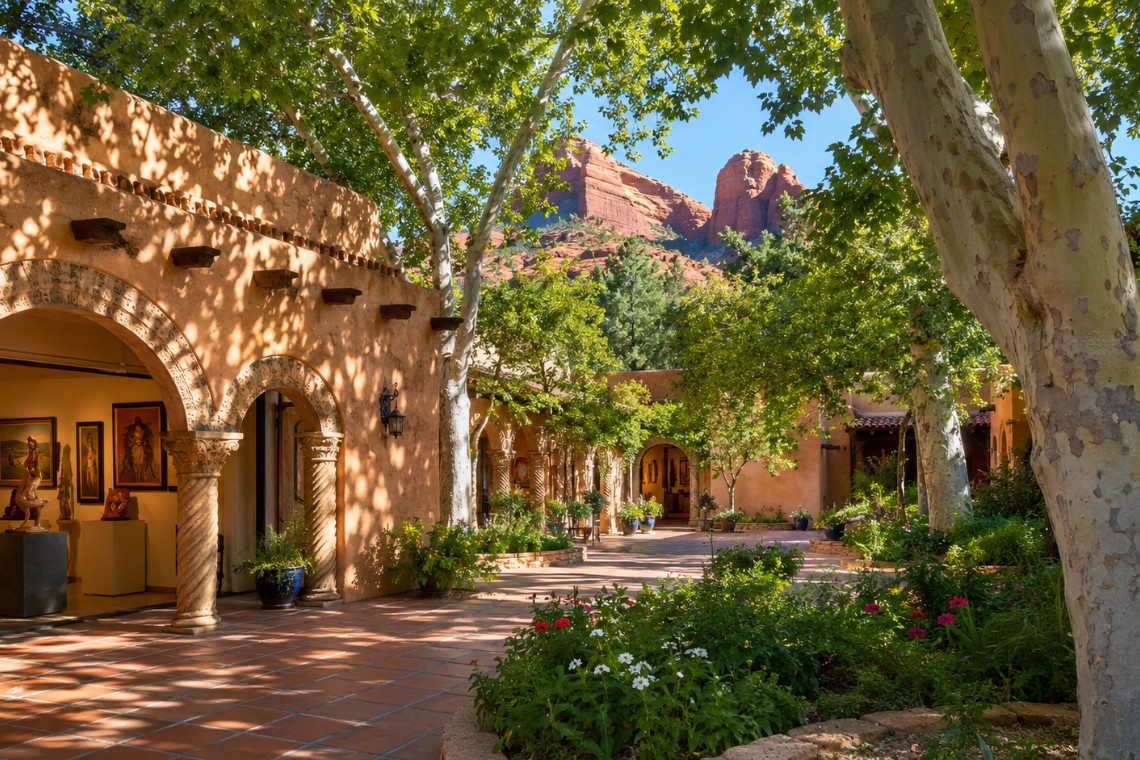
Abe Miller spent thirty years building Tlaquepaque. He was not in a hurry, and the pacing shows in every detail. Beginning in the 1970s, he assembled a series of studios, courtyards, and bell towers on a property beside Oak Creek in Sedona, Arizona, modeling the architectural character on a specific artisan neighborhood in Guadalajara, Mexico rather than on any conventional American retail model. He planted sycamore trees that were already mature and that now grow through the walkways and shade the courtyards completely. He added hand-painted tiles, ironwork, fountains, and a mission-style chapel. He brought in craftspeople and galleries and waited for the reputation to build.
What resulted is one of the most genuinely distinctive retail and arts destinations in the American Southwest, and also one of the most consistently misunderstood. People driving past on Highway 89A see the exterior archway and assume gift shop complex. The interior is something entirely different.
What Tlaquepaque Actually Is
Tlaquepaque Arts and Shopping Village is located in Uptown Sedona, Arizona, on the south side of Highway 89A at its intersection with State Route 179, adjacent to Oak Creek. The name is pronounced tla-KAY-pah-kay and refers to a historic artisan barrio in Guadalajara, Jalisco, Mexico that was the architectural and cultural model for the Sedona complex.
The property encompasses a series of interconnected courtyards, covered walkways, and individual studio and gallery buildings that use the visual vocabulary of a traditional Mexican village: terracotta roof tiles, plastered walls in warm earth tones, arched doorways, ironwork railings, and tile details embedded in walls and floors throughout. The sycamore trees that Miller planted now dominate the courtyard canopy, providing deep shade in summer and a dramatic structural element in all seasons.
The Galleries and Studios: What You Actually Find Inside
Tlaquepaque houses approximately 40 galleries and studios at any given time. The mix is weighted toward fine art and craft rather than gift retail, which is the distinction that most visitors who approach with low expectations fail to anticipate.
The art categories represented span oil and watercolor painting, bronze sculpture, hand-crafted jewelry design, pottery and ceramic art, furniture and decorative objects, blown glass, and textile art. The work is primarily by Arizona and Southwest artists, though the roster changes as studios turn over. Price points range from accessible entry-level pieces under $200 to significant original works in the five-figure range from established artists with national reputations.
Several galleries within Tlaquepaque have been operating for decades and carry work that serious art collectors specifically seek out on visits to Sedona. The galleries at this level are not curio shops. They are functioning art businesses with represented artists, exhibition programs, and clients who visit specifically to see new work rather than to browse the general inventory.
Dining at Tlaquepaque
The dining options within Tlaquepaque have evolved substantially since the complex’s early decades. Several restaurants and cafes operate within the complex, with seating that extends into the courtyards during comfortable weather. Dining in the Tlaquepaque courtyard in spring or fall, with the sycamore canopy overhead, the fountain audible from the table, and the mission-style architecture framing the view, is one of the more distinctive dining experiences in the Sedona area.
Specific restaurant tenants change over time. The Tlaquepaque website maintains current dining listings. The general character of the complex favors upscale casual dining over quick service, and the courtyard seating is the primary reason to choose it over other dining options in the area.
Events at Tlaquepaque
Tlaquepaque hosts a calendar of arts events throughout the year that draw visitors specifically rather than incidentally. The most significant are:
The Fiesta del Tlaquepaque in May brings enhanced entertainment, special exhibitions, and a festival atmosphere that fills the courtyards with activity beyond the standard gallery browsing. It is one of the most attended single-day events in Sedona.
The Festival of Lights in December is the other landmark event. The complex fills its entire walkway network with luminarias, the traditional southwestern candle-lit paper bag lanterns, on a specific December evening. The visual effect in the dark, with thousands of luminarias lining the pathways and archways, is one of the more cited experiences by long-term Sedona residents when describing what is specific about living here.
Other events include artist receptions, jazz nights in the courtyards, and wine tasting events. The events calendar is published on the Tlaquepaque website and is worth checking before a visit, particularly in spring and fall when programming is most active.
Tlaquepaque for the Visitor Versus the Resident
Visitors to Sedona, Arizona typically experience Tlaquepaque once, as part of a broader day. Residents experience it differently: as a place to take out-of-town guests, to browse periodically when new exhibitions arrive, to bring children for the architectural character, to eat lunch on a slow weekday. The complex earns repeat visits in a way that most commercial destinations do not because the galleries rotate their inventory and the setting remains consistently pleasant.
Tlaquepaque is the specific reason that several Sedona residents mention Gallery Row and the 89A/179 intersection area when asked what they value most about their Uptown proximity. It is the arts community anchor for this side of Sedona.
Tlaquepaque and Uptown Sedona Real Estate
Buyers evaluating Uptown Sedona properties who value walkable access to the arts corridor consistently identify Tlaquepaque as part of the value proposition of the address. The complex sits at the transition between Uptown and the Highway 179 corridor, making it accessible on foot from the northern Uptown neighborhood in approximately 10 to 15 minutes for most properties.
Properties in the northern and central sections of Uptown Sedona have the most practical pedestrian access to Tlaquepaque. Angelo Davis, REALTOR® at RE/MAX Sedona, works with buyers who value arts access as a lifestyle criterion and understands which Uptown addresses translate that value most directly.
The Architecture: What Makes It Feel Real
The architectural coherence of Tlaquepaque in Sedona, Arizona is not accidental. Abe Miller was specific about his model and disciplined in executing it. The mission-style stucco walls, the terracotta roof tiles, the hand-painted Talavera tile details embedded in archways and stairwells, and the ironwork railings and lanterns were all sourced or created to match the Guadalajara original rather than adapted from convenient domestic alternatives.
The result is a property that feels genuinely constructed rather than themed. The difference between a building designed to look Mexican and one built with the actual materials and craft traditions of that architecture is palpable in person. Visitors who have spent time in historic Mexican colonial cities recognize what they are seeing.
The mature sycamore trees are the element most visitors cite as the detail that makes the complex feel real. Trees that large cannot be installed. They have to be planted and grown, which means the property’s character is partly a function of the decades invested. The shade they provide in summer transforms what would otherwise be a hot courtyard into a genuinely comfortable environment. In fall, when the leaves turn gold and orange against the warm-toned walls, the canopy is one of the more photographed seasonal moments in the Sedona area.
The fountains distributed through the courtyard network add an acoustic layer to the experience. The sound of water in the Sedona, Arizona high desert has a specific effect: it makes the ambient temperature feel lower than it is and creates a sense of shelter from the wide open landscape outside the complex walls. This is not incidental. Miller understood what he was building.
Frequently Asked Questions
What is Tlaquepaque in Sedona, Arizona?
Tlaquepaque Arts and Shopping Village is a collection of approximately 40 galleries, studios, and restaurants built in the architectural style of a traditional Mexican village beside Oak Creek in Uptown Sedona, Arizona. It was developed over 30 years beginning in the 1970s by Abe Miller and is modeled on an artisan neighborhood in Guadalajara, Mexico. It houses primarily fine art, craft, sculpture, and jewelry by Southwest artists.
How do you pronounce Tlaquepaque in Sedona?
Tlaquepaque in Sedona, Arizona is pronounced tla-KAY-pah-kay. The name refers to a historic artisan barrio in Guadalajara, Jalisco, Mexico that was the architectural and cultural model for the Sedona complex.
Is Tlaquepaque in Sedona worth visiting?
Tlaquepaque in Sedona, Arizona is worth visiting for anyone interested in Southwest fine art and craft, architectural character, or dining in an unusual setting. The complex is architecturally distinctive, with mature sycamore trees dominating the courtyard canopy and mission-style buildings creating a setting unlike anywhere else in Sedona. Visitors expecting a standard gift shop complex consistently find it more substantial.
What galleries are in Tlaquepaque Sedona?
Tlaquepaque in Sedona, Arizona houses approximately 40 galleries and studios representing Southwest artists in categories including oil and watercolor painting, bronze sculpture, jewelry design, pottery, blown glass, and textile art. Gallery tenants change over time. The Tlaquepaque website maintains a current gallery directory with contact information.
What events does Tlaquepaque have in Sedona?
Tlaquepaque in Sedona, Arizona hosts two major annual events: the Fiesta del Tlaquepaque in May and the Festival of Lights in December. The Festival of Lights fills the complex’s walkways with thousands of luminarias on a December evening and is one of the most consistently cited experiences by long-term Sedona residents. Artist receptions and cultural events occur throughout the year.
Is there parking at Tlaquepaque in Sedona?
Tlaquepaque in Sedona, Arizona has a free parking area adjacent to the complex off Highway 89A and State Route 179. The lot fills on busy weekend days and during major events. The complex is also walkable from properties in northern Uptown Sedona and accessible from several public parking areas in the broader Uptown corridor.
—
If you are weighing Uptown Sedona properties and proximity to the arts corridor is part of your daily lifestyle priority, explore Uptown Sedona homes for sale to understand what addresses put you within walking reach of this specific amenity.
