The Chapel Area and Tlaquepaque Corridor: Sedona’s Spiritual and Artistic Heart
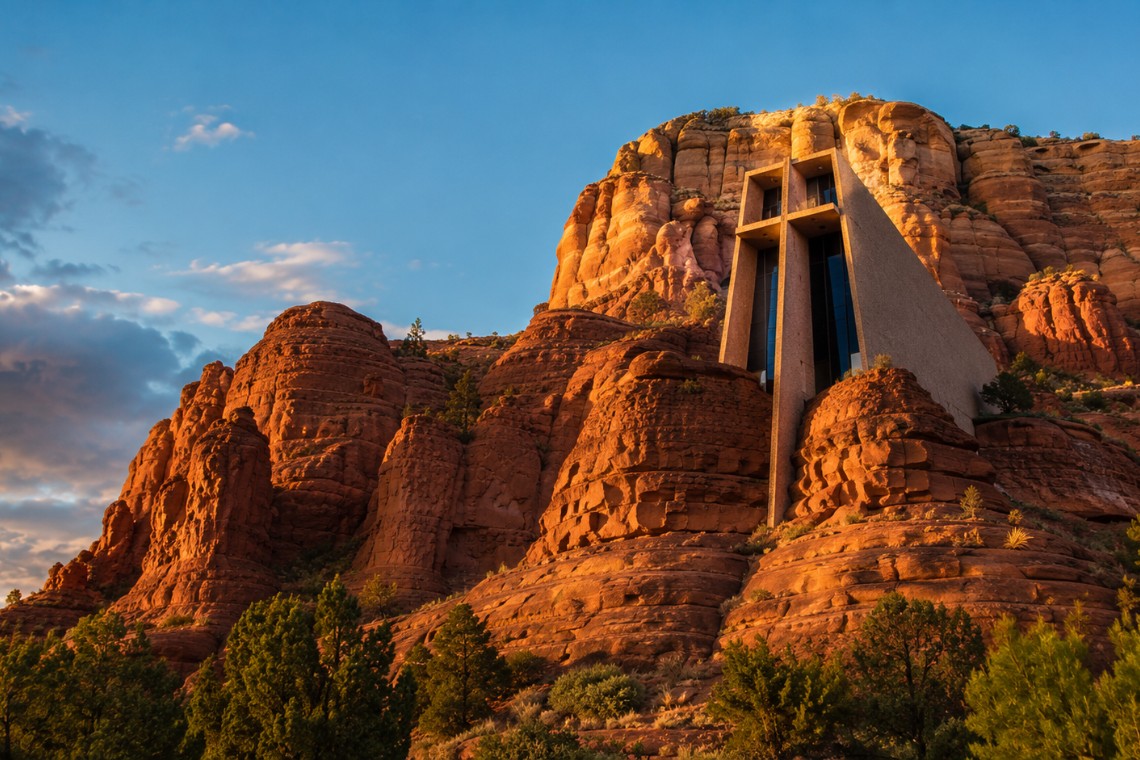
There’s a moment when you’re driving up towards the Chapel of the Holy Cross in Sedona when the landscape stops being merely dramatic and becomes spiritual. The red rocks part and frame the white cross in a way that makes architecture feel incidental. The building is there because it belongs there, not because anyone needed to convince geology to accept it.
If you live in the Chapel Area, that moment is your daily context. It’s your visual anchor. It’s the intersection of geography, faith, and human aspiration that defines this particular neighborhood in ways that no other Sedona area quite matches.
The Chapel Area isn’t a master-planned neighborhood. It’s a collection of properties organized around two of Sedona’s most significant destinations: the Chapel of the Holy Cross itself and Tlaquepaque Arts and Crafts Village at the neighborhood’s base. Living here means living at the intersection of spirituality and creativity, where both feel substantive rather than performed.
The Chapel of the Holy Cross: Geography as Architecture
The Chapel of the Holy Cross was built in 1956 by architect Blaine Drake and sits 250 feet above the valley floor, constructed directly into a red rock formation. The white cross extends 90 feet above the chapel structure. From almost any point in the Chapel Area, the chapel is visible.
This isn’t subtle background scenery. This is a landmark that shapes your visual field and your psychological field every single day. People who live in the Chapel Area describe it differently than people who visit it. For residents, it’s not a destination. It’s the center of the world you’ve chosen to inhabit.
The Chapel draws hundreds of visitors daily, especially during peak seasons. It creates foot traffic in the neighborhood. Some residents view this as a feature (access to an extraordinary spiritual space, constant reminder of Sedona’s unique positioning) and some view it as a limitation (crowds, parking, traffic). Both perspectives are legitimate.
Tlaquepaque Arts and Crafts Village: Commerce That Actually Matters
Tlaquepaque sits immediately south of the Chapel Area and has become one of Sedona’s signature destinations. It’s open-air, Spanish-influenced architecture built around galleries, restaurants, shops, and artist studios. Most importantly, it’s not generic commercialism. It’s an actual community hub for artists and craftspeople.
Living in the Chapel Area means living minutes from Tlaquepaque. You’re not visiting on special occasions. You’re having regular dinners there. You’re browsing galleries on Saturday afternoons. You’re seeing the same gallery owners and restaurant staff repeatedly enough to be familiar faces.
For people who value arts and culture, who actually spend time in galleries and care about the creative community, this proximity is enormous. Tlaquepaque isn’t just accessible. It’s integrated into your weekly life. You can walk to it on nice days. You can pop down for dinner without much planning.
The commercial activity also means there’s a genuine neighborhood pulse. There are people on the streets. There’s energy. There are seasonal visitors, which brings a certain vitality that purely residential neighborhoods don’t have.
Architectural Character and Home Types
The Chapel Area doesn’t have a single architectural voice. Homes here reflect the eclectic nature of Sedona more broadly, but with a particular emphasis on Southwestern Territorial style, contemporary designs that respond to the red rock context, and custom builds that capitalize on the dramatic geology.
What ties properties together visually is how they respond to the landscape. Homes in the Chapel Area tend to have large windows oriented toward views, to use earth tones and natural materials, and to feel integrated with rather than imposed upon the landscape. There’s a design consciousness here that creates coherence even across very different building styles.
Home sizes vary considerably. You’ll find everything from smaller 2,000 square foot original homes from the 1970s to large 4,500+ square foot contemporary custom builds. The variation is intentional. The neighborhood has capacity for different budgets and different visions of Sedona living.
Micro-Geography: Canyon Walls and Canyon Living
The Chapel Area sits in a particular geographic pocket that’s defined by canyon walls, red rock formations, and seasonal creek flow. Some properties sit directly adjacent to Sedona’s creek systems. Others have canyon walls as immediate backyard borders.
This creates an almost fortress-like quality to some properties. You’re not just looking out at the landscape. You’re living within it. Canyon walls that rise directly behind homes mean limited views in some directions but profound geological drama in others. This is either profoundly appealing or mildly claustrophobic depending on your preference.
Homes with creek access have water as part of their asset base. Sedona’s creek flows seasonally, so this isn’t year-round swimming. But properties with creek access and creek sounds and creek-based landscaping offer a different kind of living environment. You’re integrated with natural water flow in ways that are rare in Arizona real estate.
Proximity to Sedona’s Natural Attractions
The Chapel Area sits strategically close to multiple hiking trailheads. Cathedral Rock Trail is accessible and iconic. Templeton Trail provides moderate-to-strenuous hiking with views of Courthouse Butte and Bell Rock. Oak Creek Canyon is immediately accessible for drives and scenic exploration.
If you’re moving to Sedona specifically for hiking and outdoor access, the Chapel Area delivers that without requiring you to drive to the trailhead. The access is built into the neighborhood. You can hike before work. You can take trail breaks from your home office. The outdoor lifestyle that brings people to Sedona in the first place is immediately integrated.
The Spiritual Dimension: Chapel Community
The Chapel of the Holy Cross hosts weekly services, but its significance extends beyond formal religion. The space attracts people from all spiritual traditions and no particular tradition. It’s become a meditation space, a place for contemplation, and a landmark that represents something larger than commerce or tourism.
Some residents in the Chapel Area are explicitly drawn by this spiritual dimension. Others are drawn by the aesthetics and views and aren’t particularly focused on the spiritual aspect. The neighborhood accommodates both, and that combination is part of what makes it distinctive. You can live here in a purely secular way, and you can live here with faith as central to your choice.
Seasonal Considerations and Traffic Patterns
The Chapel Area experiences significant seasonal variation in foot traffic and visitor volume. Peak seasons, typically October through April, bring substantial tourism to the Chapel and Tlaquepaque. Summer and monsoon season bring quieter periods.
For full-time residents, this rhythm becomes part of the neighborhood identity. You learn when to avoid Tlaquepaque for dining (weekends in season) and when you can access it more freely (weekday afternoons in summer). You experience the neighborhood at different scales depending on the season.
Some residents embrace this seasonal pulse. Others find it limiting. The fact that you’re living adjacent to one of Sedona’s primary destinations means you’re inherently connected to its commercial rhythms.
Real Estate Market Dynamics
The Chapel Area sits in the middle of Sedona’s price range. It’s more expensive than Big Park but somewhat less expensive than the highest-end Uptown properties. Homes here typically range from $800,000 to $2.5 million, with significant variance based on size, views, and specific location.
The neighborhood market is relatively stable. Properties move at a moderate pace. There’s enough selection that you’re not competing desperately for one of three homes. There’s not so much supply that pricing is undifferentiated.
The neighborhood also attracts a particular demographic: people who value spirituality or culture or both, who prioritize the arts community, and who want to be integrated into something larger than pure residential life. This creates a self-selecting community that has certain shared values.
Walkability and Daily Life
The Chapel Area sits between two worlds. Tlaquepaque is walkable (though the actual walk involves hills and red rock). Uptown Sedona is a short drive. The Chapel itself is accessible but requires climbing stairs carved into the rock.
You’re not in a fully walkable neighborhood in the traditional sense. But you’re in a neighborhood where walking leads somewhere worth walking to. The walkability isn’t about density. It’s about destination.
For daily groceries and routine shopping, you’ll drive to Uptown or other commercial areas. But for dinner, gallery browsing, and certain forms of community engagement, the neighborhood is genuinely walkable and self-contained.
The Arts Community and Cultural Integration
Sedona has a legitimate arts community, and a disproportionate amount of it is concentrated around Tlaquepaque and the Chapel Area. You’ll find artists in residence, galleries featuring actual working artists (not just tourist shops), and a genuine creative infrastructure.
Living in the Chapel Area means living inside this arts ecosystem rather than accessing it. The boundary between where artists live and where they work and where the general community gathers is genuinely porous here. You’re not living in an artists’ neighborhood that’s been gentriified and converted to residential. You’re living in an active creative community.
Who Thrives in the Chapel Area?
The Chapel Area works best for people who are drawn to Sedona specifically for its spiritual reputation or its arts community or both. It works for empty-nesters who don’t need to be close to schools or employment and want to prioritize lifestyle and cultural access. It appeals to people who value walking to restaurants and galleries over suburban convenience.
It’s less ideal for families with young children (due to the walking distances and canyon geography), for people who prioritize maximum privacy (foot traffic exists), and for those who want a purely quiet residential experience without any commercial or cultural component.
Real Estate Fundamentals
When you’re evaluating Chapel Area homes, pay particular attention to views, canyon proximity, creek access, and relative elevation. The red rock formations aren’t uniformly visible from every property. Some homes have dramatic views. Others are tucked into canyons where views are limited. Both have value, but they’re profoundly different living experiences.
Canyon walls that appear scenic in photographs can mean limited light at certain times of day. Creek proximity is beautiful but can mean seasonal water issues. Elevation changes in the neighborhood mean that what looks flat on a listing might involve significant climbing in real life.
Working with someone who knows the specific properties, the specific geology, and the specific trade-offs that each location entails becomes important. The neighborhood is nuanced in ways that require local expertise.
Exploring the Chapel Area
If you’re drawn to Sedona specifically for its spiritual significance, its arts community, or the idea of living at an intersection of culture and geology, the Chapel Area deserves serious consideration. It’s not everyone’s neighborhood, but for the right person, it’s not really a neighborhood at all. It’s a home base for a completely different way of living.
Explore Chapel Area and other Sedona communities to understand the specific neighborhoods and their character. When you’re ready to look at specific properties, reach out to Angelo Davis to discuss the nuances of this particular corner of Sedona and what’s available now.
—
