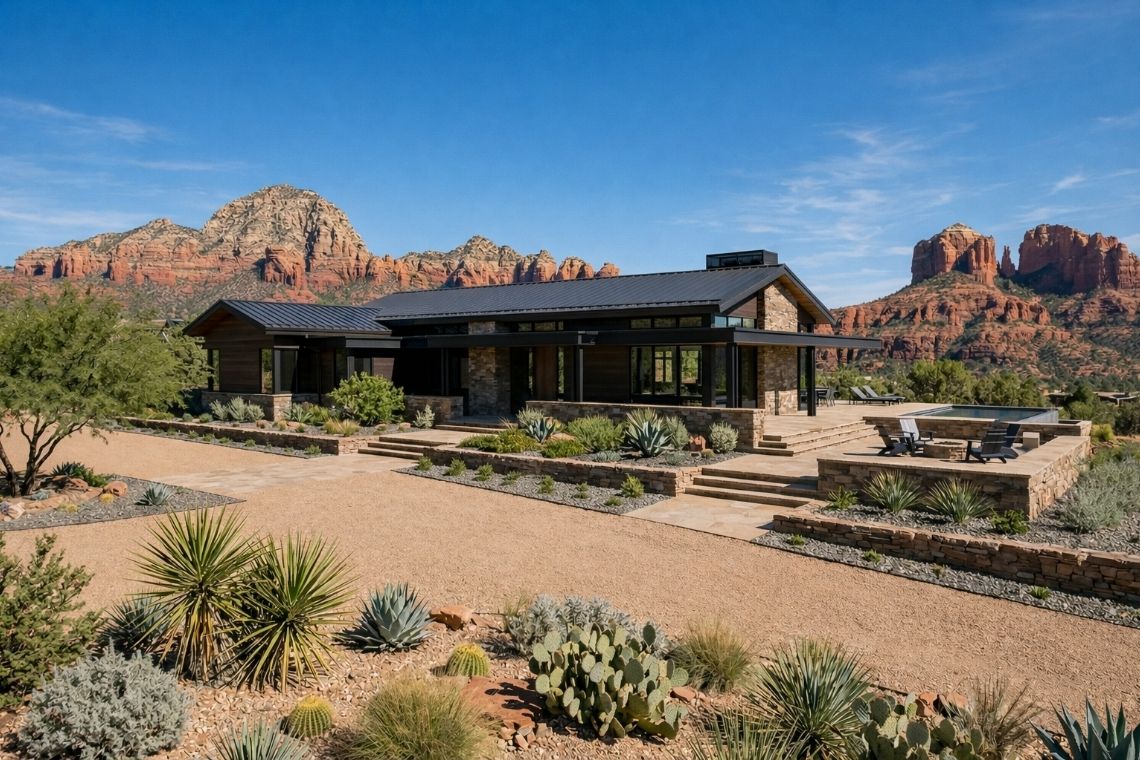
A disclosure that appears in virtually every Sedona, Arizona real estate transaction is the wildfire risk designation.
For buyers from urban metros or the coasts, this may be the first time they’ve seriously engaged with fire risk as a property consideration. For buyers from Western states, it’s familiar. In either case, understanding what the disclosure actually means — and what it doesn’t mean — is essential before you close on a Sedona property.
Why Wildfire Risk Matters in Sedona
Sedona, Arizona is situated within the high desert of northern Arizona, surrounded by 1.8 million acres of Coconino National Forest. The vegetation in and around Sedona includes juniper, pinyon pine, manzanita, scrub oak, and ponderosa pine at higher elevations. These are fire-adapted species in a climate that periodically produces the conditions — drought, heat, wind — that support wildfire.
According to risk analysis firms that assess long-term wildfire probability, essentially 100% of properties in Sedona carry some wildfire risk designation over a 30-year horizon. This sounds alarming in isolation. In context, it means that Sedona is in a Western landscape where wildfire is a natural and recurring environmental process, not an unusual catastrophic event.
The practical implication for buyers is not whether risk exists — it does — but how to understand the specific risk profile of a property and how that risk is managed through insurance and property preparation.
Wildfire Risk Disclosures in Arizona Real Estate
Arizona sellers are required to disclose known material defects and conditions affecting the property. Wildfire risk is disclosed through the AAR Residential Resale Real Estate Purchase Contract and the seller’s property disclosure statement (SPDS).
The Arizona State Forestry Division maintains a map of State Responsibility Areas (SRAs) — lands where the state has primary fire suppression responsibility. Properties in SRAs carry a specific designation that appears in real estate disclosures.
Additionally, third-party risk assessment companies like First Street Foundation produce property-level wildfire risk scores that are increasingly referenced in real estate transactions, lender assessments, and insurance underwriting.
Insurance Implications
Homeowner’s insurance in wildfire-prone areas of Arizona has become more complex and more expensive in recent years. Some national carriers have reduced their exposure in high-risk Western markets, and Sedona buyers should not assume that standard homeowner’s insurance at standard rates will be readily available for all properties.
Before closing on a Sedona property, confirm that you can obtain homeowner’s insurance at a cost that is factored into your ownership budget. Request insurance quotes before the close of escrow — not after. Some properties in Sedona, particularly those in dense vegetation corridors or with limited defensible space, may require surplus lines insurance at significantly higher premiums.
Your insurance agent or broker should be engaged early in the transaction, not at the closing table.
Defensible Space: What It Is and Why It Matters
Defensible space is the buffer of vegetation management around a structure that slows the spread of fire and improves the survivability of the structure in a wildfire event.
Arizona law and many HOA CC&Rs in Sedona require homeowners to maintain defensible space around their structures. The standard typically involves a zone of reduced vegetation within 30 feet of the structure and a reduced fuel zone extending beyond that.
When evaluating a Sedona property, assess the current state of defensible space. Dense, unmanaged juniper and scrub oak directly adjacent to a structure is a hazard and a potential insurance liability. The cost of vegetation management is a recurring ownership expense that should be factored into the total cost of ownership.
The Sedona Fire District
The Sedona Fire District provides fire protection services to most of the Sedona area, including fire suppression, emergency medical services, and community fire preparedness programs.
Properties within the Sedona Fire District benefit from professional fire protection infrastructure. Properties outside the district, or in rural areas at the farthest extent of the district’s coverage, may have longer response times and should be evaluated accordingly.
Sedona Fire District assessments appear as a line item on property tax bills and represent a property tax component separate from county property taxes.
How to Evaluate Wildfire Risk for a Specific Property
When evaluating a specific Sedona, Arizona property for wildfire risk, consider these factors.
Vegetation density and management around the structure. A property with well-maintained defensible space in a managed HOA community is meaningfully different from a rural property with years of accumulated brush directly adjacent to the home.
Access. Can emergency vehicles reach the property on a road that would be safe during a fire event? Properties in Red Rock Loop and Oak Creek Canyon that are on single-access roads should be evaluated with this in mind.
Construction materials. Newer Sedona homes are often built with fire-resistant materials — tile roofing, stucco exteriors, dual-pane windows. Older construction with wood siding or wood shake roofing carries higher fire risk.
Frequently Asked Questions: Wildfire Risk in Sedona, Arizona
Is Sedona, Arizona at high risk for wildfires?
Sedona, Arizona is in a high desert landscape surrounded by National Forest where wildfire is a natural part of the ecosystem. Third-party risk assessments indicate essentially all properties in Sedona carry some wildfire risk over a 30-year horizon. Buyers should understand the specific risk characteristics of any property they’re purchasing and plan accordingly for insurance and defensible space maintenance.
Can I get homeowner’s insurance on a Sedona property?
Homeowner’s insurance is generally available for Sedona, Arizona properties, but the market has tightened as national carriers have reduced exposure in wildfire-prone Western markets. Premiums can be significantly higher than buyers from lower-risk markets expect. Confirm insurance availability and cost before closing by engaging your insurance agent early in the transaction.
What is defensible space and am I required to maintain it in Sedona?
Defensible space is a buffer of managed vegetation around a structure that slows fire spread. Arizona law requires it for properties in State Responsibility Areas, and many Sedona HOAs independently require it. The standard typically involves a zone of reduced vegetation within 30 feet of the structure. Read about HOA requirements in Sedona here.
Has Sedona had major wildfires in recent years?
The Sedona area has experienced significant wildfire events in recent decades, including fires in the surrounding National Forest that required evacuations of some neighborhoods. The Slide Fire of 2014 in Oak Creek Canyon is among the most significant recent examples. None have resulted in mass destruction of residential neighborhoods, but they underscore the importance of fire preparedness for Sedona homeowners.
How does wildfire risk affect property values in Sedona?
Wildfire risk disclosure is a standard component of Sedona real estate transactions, and the market prices it as an ongoing ownership cost rather than a value impairment for most properties. Well-maintained properties with good defensible space, modern construction materials, and fire district coverage price normally within their market segment.
What should I look for during a property inspection related to fire risk?
Evaluate defensible space vegetation management, roof material and condition (tile preferred over wood shake), exterior siding material, window quality, access road conditions and width, and distance from the nearest fire hydrant or water source. Ask your agent about the property’s proximity to any State Responsibility Area designation and request the First Street Foundation wildfire risk score for the address.
Wildfire risk is a real and manageable consideration for Sedona homeowners — not a reason to avoid the market, but something to understand clearly before you buy. Reach out to Angelo Davis, REALTOR® at RE/MAX Sedona, at (928) 274-9114 if you have questions about specific properties and their wildfire risk profiles.
