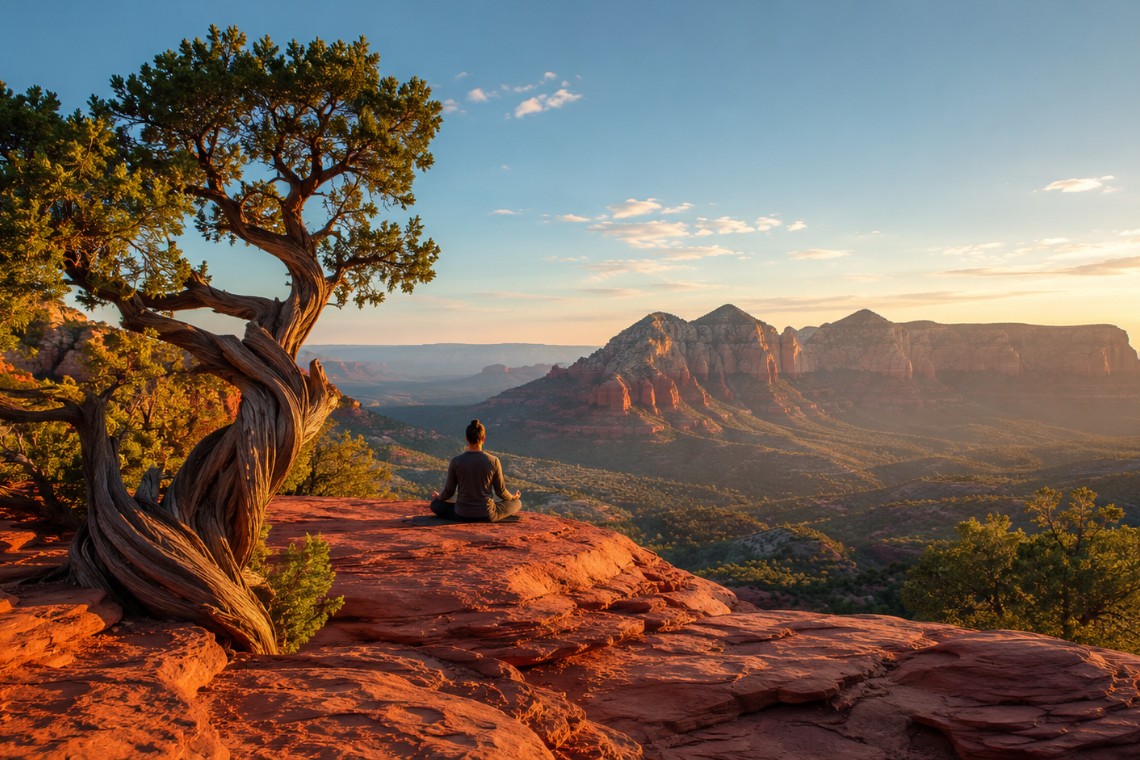
The first thing to understand about the Sedona, Arizona vortexes is that they are not in dispute among the people who visit them. The second thing to understand is that nobody fully agrees on what they are. Geologists describe electromagnetic anomalies and the influence of iron-rich sandstone on local magnetic fields. Spiritual practitioners describe intersections of the earth’s energy field where specific qualities of upflow or inflow energy are concentrated. Most first-time visitors describe something more pragmatic: a feeling of heightened awareness, an unusual physical sensation in the hands or arms, or simply the observation that the juniper trees near the vortex sites grow in spiraling patterns that are not found elsewhere in the desert.
Sedona has four recognized vortex sites. Here is what you actually find at each of them, separated from what the marketing says about them.
The Four Recognized Sedona Vortex Locations
Airport Mesa is in West Sedona, Arizona, reached via a short hike from the Airport Mesa overlook parking area on Airport Road. The drive from the Y intersection takes approximately 5 minutes. The hike to the mesa summit is approximately 0.5 miles each way with moderate elevation gain. The 360-degree view from the top of the mesa, covering the full Sedona formation landscape in every direction including Cathedral Rock to the south, the Boynton Canyon corridor to the west, and the canyon entrance to the north, is one of the best single-viewpoint panoramas in Sedona accessible on a short hike.
Airport Mesa’s vortex is described as an upflow energy center. The physical evidence most commonly cited at this site is the concentration of spiral-trunk juniper trees on the mesa summit. These trees grow in helical patterns that are distinctly different from junipers elsewhere at similar elevations. The summit is also one of the most popular sunset viewing points in Sedona, which means late afternoon visits in spring and fall are crowded.
Bell Rock is in the Village of Oak Creek, Sedona, Arizona, along Highway 179 approximately 6 miles south of the Y intersection. The vortex is associated with the base and lower slopes of the Bell Rock formation and is accessible from the Bell Rock Pathway trailhead parking area. Bell Rock’s vortex is described as an upflow energy center. The formation’s isolated position rising directly from the desert floor with no other formations immediately adjacent gives the Bell Rock site a different character from the canyon-enclosed Boynton Canyon vortex. The spiral-trunk juniper evidence is visible in the scrub desert surrounding the formation base.
Cathedral Rock vortex is in the Red Rock Loop area of Sedona, Arizona, near the base of the Cathedral Rock formation. Access is via the Cathedral Rock trail from Back O’ Beyond Road. The vortex is described as an inflow energy site, drawing energy inward rather than pushing it outward. Practitioners describe Cathedral Rock as the feminine vortex counterpart to the masculine upflow sites at Bell Rock and Airport Mesa. The site is associated with the saddle area between Cathedral Rock’s main spires, accessible on the trail before the summit scramble section. The creek crossing at Red Rock Crossing below this area adds a water element to the Cathedral Rock vortex experience that the other sites do not have.
Boynton Canyon vortex is in West Sedona, Arizona, approximately 0.5 miles from the Boynton Canyon trailhead on the main trail. The vortex is associated with a sandstone spire called the Kachina Woman, visible from the trail to the left as you enter the canyon. Boynton Canyon’s vortex is described as balancing energy, combining both upflow and inflow qualities, which some practitioners describe as making it the most integrative of the four sites. The spiral-trunk juniper concentration in this area is among the most visible in Sedona.
What the Vortex Experience Actually Involves
People report a range of experiences at Sedona vortex sites across a very wide spectrum. The common descriptions at the more energetically active end include tingling or buzzing sensations in the hands, arms, or chest; a feeling of emotional amplification that is not always comfortable; heightened sensory awareness; and a sense of energy moving through the body in a direction that corresponds to the site’s described upflow or inflow character.
At the less dramatic end of the reported range, visitors note nothing unusual beyond the beauty of the landscape and a general sense of wellbeing. This is also a consistent observation across decades of visitor accounts. The honest position is that the experience varies significantly from person to person and from visit to visit.
The sites are on public National Forest land. Visiting them costs only the standard Red Rock Pass parking fee. There is no gatekeeper, no ceremony required, and no specific protocol necessary to have an authentic experience. You walk to the site, you are in the landscape, and whatever happens or does not happen is the experience.
The Spiral Juniper Trees: Physical Evidence of Something
The one piece of physical evidence that is universally visible and not subject to interpretation is the spiral-trunk juniper trees at Sedona’s vortex sites. These trees grow in helical patterns, their trunks twisting as they ascend, in a way that is not observed in juniper trees elsewhere in the Arizona high desert at similar elevations and soil conditions.
Whether this results from electromagnetic anomalies in the local geology, from specific soil mineral concentrations, from unusual wind patterns at these particular sites, or from some other factor, has not been definitively resolved. The trees are real, the pattern is distinctive, and they are most concentrated at and near the four recognized vortex locations. This makes them the most reliable navigation tool for finding the actual vortex sites even without a guide.
Guided vs. Self-Guided Vortex Visits
Sedona, Arizona has a well-established community of vortex guides offering tours that range from 1 to 4 hours at varying price points. The guides bring historical context, geological and spiritual framing, and individual attention to the experience that a self-guided visit without preparation does not have. For first-time visitors who want to understand the vortex framework, what they are standing in, and how to interpret their experience, a guided tour provides useful orientation.
Self-guided visits are completely valid. The four sites are well-documented, the access is straightforward, and the experience is the same regardless of whether a guide is present. People who have done both often describe the guided visit as more emotionally framed and the self-guided visit as more personally interpreted.
Vortex Sites and Sedona Neighborhoods
Two of the four vortex sites are in West Sedona, Arizona (Airport Mesa and Boynton Canyon), one is in the Village of Oak Creek (Bell Rock), and one is in the Red Rock Loop area (Cathedral Rock). This geographic distribution is worth knowing for buyers researching specific neighborhoods.
Buyers who specifically value proximity to vortex sites as a lifestyle criterion find that West Sedona properties offer the most direct access to two of the four. The Airport Mesa overlook is within 5 minutes of most West Sedona addresses. The Boynton Canyon trailhead is within 15 minutes. For buyers for whom the vortex experience is a regular practice, Angelo Davis, REALTOR® at RE/MAX Sedona, understands which specific neighborhoods and streets in Sedona deliver that proximity most directly.
Frequently Asked Questions
What are the vortexes in Sedona, Arizona?
Sedona, Arizona has four recognized vortex sites: Airport Mesa in West Sedona, Bell Rock in the Village of Oak Creek, Cathedral Rock in the Red Rock Loop area, and Boynton Canyon in West Sedona. They are described as locations where the earth’s energy field is concentrated. Physical evidence includes spiral-trunk juniper trees near each site.
Where are the four Sedona vortex locations?
The four Sedona vortex sites are: Airport Mesa, accessible from Airport Road in West Sedona, Arizona; Bell Rock, along Highway 179 in the Village of Oak Creek; Cathedral Rock, via the Cathedral Rock trail from Back O’ Beyond Road in the Red Rock Loop area; and Boynton Canyon, approximately half a mile from the Boynton Canyon trailhead in West Sedona.
Do the Sedona vortexes cost money to visit?
The Sedona vortex sites in Arizona are on public National Forest land and are free to access. Trailhead parking requires the Red Rock Pass at $5 per vehicle. The America the Beautiful annual pass covers parking fees. Guided vortex tours are available from local guides at varying prices.
What does a Sedona vortex feel like?
Sedona vortex experiences in Arizona vary significantly among visitors. Common reported sensations include tingling in the hands and arms, emotional amplification, and heightened sensory awareness. Some visitors report strong physical sensations. Others report nothing unusual beyond the beauty of the landscape. The range is consistent across decades of documented accounts.
Which Sedona vortex is best for beginners?
Airport Mesa in West Sedona, Arizona is consistently recommended for first-time vortex visitors. The hike is short, the summit provides the best 360-degree orientation to the full Sedona landscape, and the spiral-trunk juniper trees provide clear visible physical evidence associated with the site. Bell Rock is also highly accessible as a starting point with minimal hiking required.
Are the spiral trees at Sedona vortex sites real?
Yes. The spiral-trunk juniper trees at Sedona’s vortex sites in Arizona are a well-documented physical phenomenon. The trees grow in helical patterns not observed in juniper trees at comparable elevations elsewhere in the Arizona high desert. They are most concentrated near Airport Mesa, Boynton Canyon, Bell Rock, and Cathedral Rock, the four recognized vortex sites.
—
If you have been researching Sedona and the vortex question has been part of your research, the honest answer is: go and find out. Pass this along to someone who has been on the fence about visiting.
