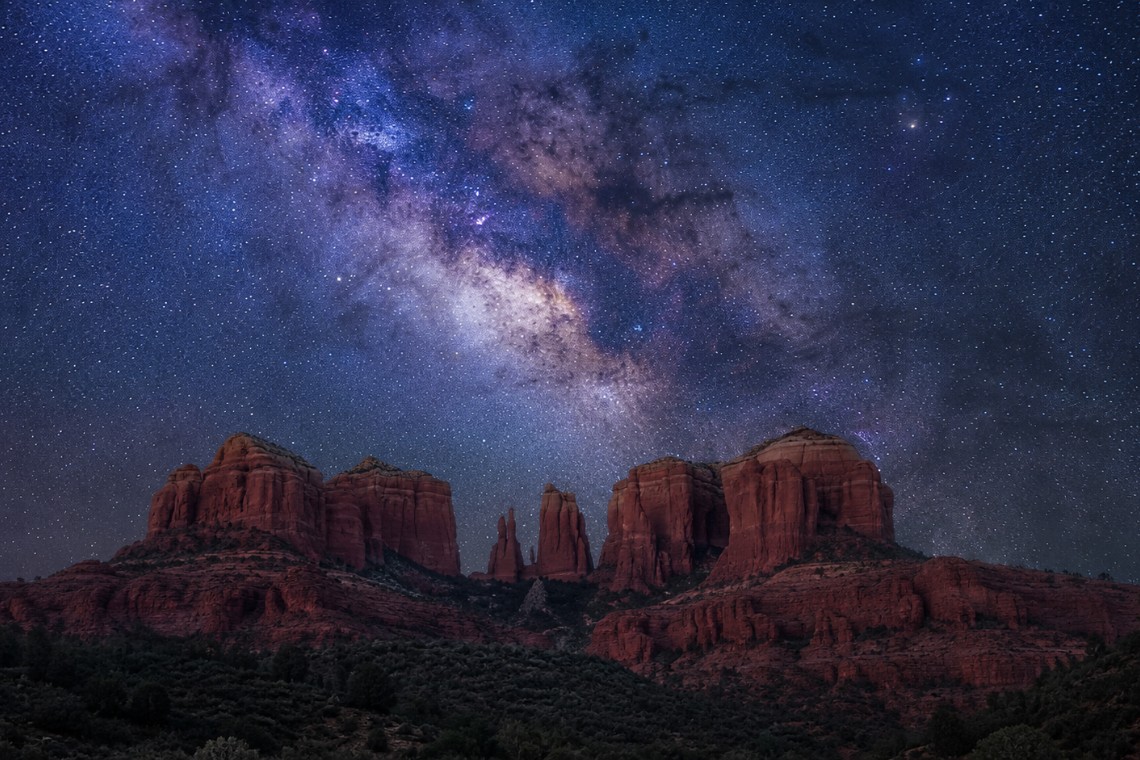
Somewhere around the third or fourth night after moving to Sedona, Arizona, people from major cities step outside and stop. They are not looking at the formations. The formations disappear after dark. They are looking up. At what they can actually see. The Milky Way is not something most people from Los Angeles, Chicago, or New York have ever seen with the naked eye in any meaningful way. In those cities, what most people call the Milky Way is a faint smudge, if it is visible at all. In Sedona on a clear moonless night, it is a physical structure that extends from one horizon to the other, a luminous band with visible depth and what appears to be texture when the eye adjusts fully to the dark.
This is a routine Tuesday night in Sedona for people who live there and step outside. It does not become less remarkable. You do not stop noticing it.
Why Sedona’s Dark Sky Is Genuinely Exceptional
Sedona, Arizona sits at approximately 4,300 feet elevation with no major metropolitan area within 100 miles to the north or west. Flagstaff, 28 miles north and at 6,900 feet elevation, enacted the world’s first outdoor lighting ordinance specifically to protect dark skies in 1958 and has maintained that commitment since. This makes Flagstaff the anchor of one of the darkest inhabited corridors in the American West, and Sedona benefits from that protection.
The light pollution that exists in Sedona comes primarily from the Uptown and Highway 179 commercial corridors and from Phoenix’s glow on the distant southern horizon. The commercial lighting is locally significant but geographically contained. Drive 3 to 5 minutes from the commercial corridor in any direction into the surrounding residential areas or the Red Rock Loop, and the sky darkens measurably.
Sedona’s specific topographic position, in a valley partially enclosed by red rock formations that block the peripheral horizon in multiple directions, reduces the effective light dome from distant sources. The Verde Valley floor to the south is dark. The National Forest to the north, west, and south contains no significant light sources. The result is dark sky quality that is measurably better than most inhabited areas of the American West outside of formally designated International Dark Sky Parks.
What You Can Actually See with Naked Eyes from Sedona
On a clear moonless night in Sedona, Arizona, a dark-adapted eye can see with no optical assistance:
The Milky Way galaxy as a structural band crossing the sky from south to north. The galactic core in the direction of Sagittarius above the southern horizon is visible from late June through September as the brightest and densest section of the band. Stars visible within the core region number in the thousands on a good night. The dark rift, a lane of dust and gas cutting through the bright core, is visible as a darker stripe through the brightest section.
Planets at naked-eye brightness. Venus and Jupiter are frequently bright enough to cast faint shadows at peak brilliance. Saturn, at slightly lower brightness, is still distinctly visible. Mars at opposition cycles every two years to a brightness that places it among the most visually dominant objects in the sky. The color distinctions between planets are noticeable: Venus white, Jupiter slightly cream, Saturn distinctly warm, Mars visibly reddish.
Several galaxies without optical aids. The Andromeda Galaxy is the most accessible. At approximately 2.5 million light-years distance, it is the farthest object visible to the human eye without equipment. In Sedona’s dark sky, it appears as an elongated smudge roughly six times the apparent diameter of the full moon in the northern sky in fall. The Triangulum Galaxy, the third-largest member of our local group, is visible as a very faint smudge near Andromeda on the darkest nights.
Open star clusters with naked-eye resolution. The Pleiades in Taurus resolve clearly as a tight group of six or seven stars (the number visible varies by individual visual acuity) rather than the blurry patch seen from light-polluted areas. The Hyades cluster in the same constellation provides the V-shaped face of Taurus. In winter, the Orion Nebula in Orion’s sword is visible as a hazy star that careful attention reveals as extended rather than point-like.
Best Stargazing Locations Near Sedona, Arizona
Airport Mesa overlook in West Sedona is one of the most accessible dark sky viewing points in the area. The overlook parking area is accessible after dark, the mesa provides an elevated 360-degree horizon, and the West Sedona residential surroundings have relatively low commercial lighting. This is the default recommendation for visitors who want a reliable dark sky experience without driving beyond Sedona’s commercial zone.
Schnebly Hill Road leaves Highway 89A near the base of the Schnebly Hill formation and climbs into terrain above the town’s light influence. The upper sections of Schnebly Hill Road have expansive south and east horizon views and significantly darker sky than any location at highway level. The road is 4WD territory for vehicles, but the lower pullouts accessible from the paved section are adequate for a substantial improvement in sky darkness.
Red Rock Loop Road in Sedona, Arizona, particularly the sections away from the residential properties and closest to the National Forest boundary, has some of the darkest accessible sky in the immediate Sedona vicinity. The combination of limited residential lighting in the corridor and the National Forest on multiple sides reduces the effective light dome at this location below what is achievable from West Sedona residential streets.
Anderson Mesa outside Flagstaff, approximately 25 miles north of Sedona via Highway 89A, provides even darker conditions than the Sedona area and is used by amateur and professional astronomers. The drive adds 35 to 40 minutes but delivers a meaningfully different sky quality.
Guided Stargazing Programs Near Sedona
Several astronomy tour operators in the Sedona and Flagstaff area offer guided telescope-assisted stargazing programs that typically run from spring through fall in the evening hours after astronomical twilight, approximately 90 minutes after sunset. These programs typically include equipment access for viewing Saturn’s rings, Jupiter’s moons, deep-sky objects, and star clusters at magnification levels that dramatically expand the naked-eye experience.
For visitors whose primary interest is planetary observation rather than dark-sky appreciation, the guided programs are worth the investment because the telescopes and narration change what is accessible. Saturn’s rings, visible in a modest telescope even in light-polluted conditions, are consistently cited as the single most memorable experience for first-time telescope observers. Jupiter’s four Galilean moons, visible as a row of dots flanking the planet’s disk, provide a direct view of the same configuration Galileo observed in 1609.
Dark Sky as a Sedona Lifestyle Factor
Buyers who move to Sedona, Arizona from major urban areas consistently name the dark sky as one of the unexpected pleasures of the location. It does not appear on their buyer profile during the search process. It appears in the feedback afterward, mentioned alongside the trail access and the formation views as something they value daily.
The dark sky is a function of geography that is preserved as long as the surrounding National Forest remains undeveloped and Flagstaff maintains its lighting ordinance commitment. Both of those factors have been stable for decades. Angelo Davis, REALTOR® at RE/MAX Sedona, has heard this observation from enough clients that it belongs in any honest description of what Sedona as a place delivers.
Frequently Asked Questions
Is Sedona, Arizona a dark sky area?
Yes. Sedona, Arizona has significantly lower light pollution than most inhabited areas of the American West, owing to its location at 4,300 feet elevation, limited nearby development, and proximity to Flagstaff, which has protected dark skies since 1958. The Milky Way is visible with naked eyes on clear moonless nights from most Sedona locations away from the commercial corridors.
Can you see the Milky Way from Sedona, Arizona?
Yes. The Milky Way is visible with the naked eye from Sedona, Arizona on clear moonless nights from late June through September. The galactic core in the direction of Sagittarius is visible above the southern horizon during this period and is the most structurally dramatic section of the band. Dark sky-adapted eyes require approximately 20 minutes of darkness before the full depth of the Milky Way becomes visible.
Where is the best stargazing near Sedona, Arizona?
The best accessible stargazing locations near Sedona, Arizona include the Airport Mesa overlook in West Sedona, the upper sections of Schnebly Hill Road above Highway 89A, and the Red Rock Loop area away from residential lighting. For the darkest conditions in the region, Anderson Mesa outside Flagstaff is approximately 25 miles north and provides professional-grade dark sky.
What planets can you see from Sedona, Arizona?
Venus, Jupiter, Saturn, and Mars are regularly visible with naked eyes from Sedona, Arizona. Jupiter and Venus at peak brilliance are bright enough to cast faint shadows. Saturn’s rings are visible in even a modest telescope. Jupiter’s four Galilean moons are visible with binoculars on any clear night.
Are there stargazing tours near Sedona, Arizona?
Yes. Several astronomy tour operators near Sedona, Arizona offer guided telescope-assisted stargazing programs typically running from spring through fall in evening hours after astronomical twilight. Tours include equipment access for planetary and deep-sky observation with narrated commentary.
Does Sedona have light pollution?
Sedona, Arizona has significantly less light pollution than major metropolitan areas but is not a formally designated dark sky park. Commercial corridors along Highway 89A and Highway 179 contribute local sky glow. Driving 3 to 5 minutes from these corridors into residential areas or the Red Rock Loop substantially improves sky darkness for naked-eye observation.
—
The dark sky is one of those Sedona details that most people who have not visited do not know to ask about. If you know someone evaluating a move to Arizona who has not considered Sedona, this is exactly the kind of thing worth mentioning.
