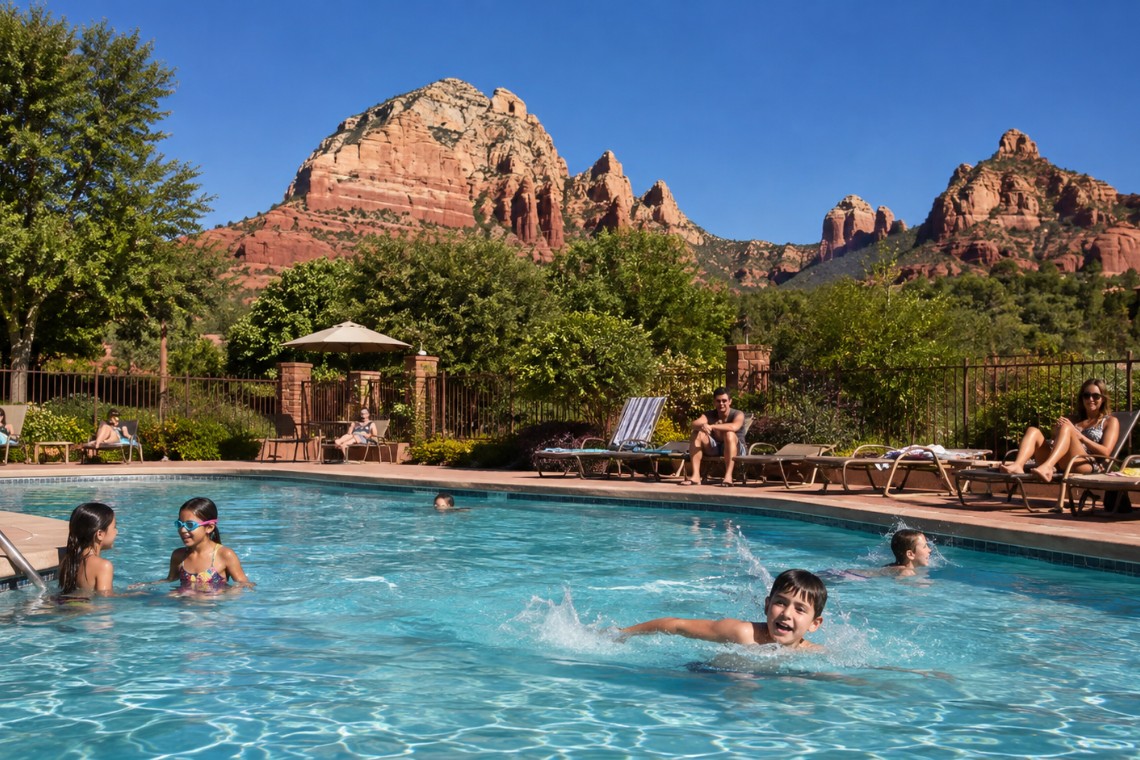
By the fourth month in their new West Sedona house, the Henderson family had hiked Bear Mountain twice, watched a dozen sunsets from the back patio, and started asking a different question. Where do the kids swim on a hot Tuesday in July, and is there a summer camp that doesn’t require a long drive.
The novelty of red rock views doesn’t cancel out the need for swim lessons, a rec league jersey, or a library card. Recreation in Sedona, Arizona looks different than it did in the suburbs many families leave behind, and understanding that difference early saves a lot of confusion.
This guide walks through what relocating families actually use once the hiking novelty settles into a normal week: the library, the community center, swimming access, youth sports, and programming for adults and seniors. It’s written for anyone considering a move to Sedona, Arizona who wants a realistic, ground-level picture rather than a brochure version of small-town recreation.
The Sedona Public Library’s Community Programming
The Sedona Public Library functions as one of the town’s most active community hubs, offering far more than book checkouts for a town of its size.
Weekly story times and early-literacy programs draw young families, while teen programs, computer and technology help sessions, and a full slate of author talks and lectures serve a wider range of ages. The library also hosts local history archives and meeting rooms that community groups use for everything from book clubs to homeowner association meetings.
For a family used to a large suburban library system with multiple branches, the single Sedona branch can feel smaller. What it lacks in square footage it tends to make up for in consistency, since the same staff and the same regulars show up week after week, and that familiarity becomes part of how newcomers meet people.
Many families end up treating a library card as one of the first things they set up after closing on a home, right alongside utility transfers.
The Sedona Community Center’s Youth and Adult Programs
The Sedona Community Center is where most of the recreation-style programming in town actually happens, filling a role that a dedicated municipal rec center might play in a larger suburban city.
Programming there tends to run in seasonal sessions and typically includes youth enrichment classes, arts and crafts, fitness and movement classes for adults, and drop-in activities like pickleball or table games depending on the season. Summer often brings day camp offerings for school-age kids, which becomes a scheduling anchor for working parents once the school year ends.
Because the facility serves the whole town rather than one neighborhood, class sizes and time slots can fill up faster than families expect coming from a city with several rec centers spread across different zip codes. Registering early, rather than waiting until the week a session starts, tends to matter more here than it did in a bigger metro area.
The community center also functions as an informal social hub. Parents waiting on a pickup often know each other from the same trailhead parking lot or the same library story time, which is part of what gives Sedona, Arizona its small-town feel even as the population grows.
Public and Semi-Public Swimming Access
Sedona does not have a large municipal swimming pool complex, and its swimming culture leans instead toward Oak Creek itself.
Slide Rock State Park and Grasshopper Point are the two spots most residents and visitors think of first, both offering natural swimming holes along Oak Creek rather than a chlorinated pool deck. They’re seasonal in feel and busiest during the hot summer months, with the experience closer to a creek day than a pool day, complete with rock slides, shaded banks, and cold water fed by canyon springs.
So where do families go for structured swim lessons or year-round lap swimming? Most residents who want that head to nearby Verde Valley or Cottonwood recreation facilities, which sit a short drive from Sedona and offer indoor, purpose-built pool programming that a creek can’t provide.
Program availability, hours, and membership details at those Verde Valley and Cottonwood facilities change over time. It’s worth verifying current offerings directly at the time of a move rather than assuming what was true a year or two ago.
For a family relocating from a city with a pool in every subdivision, this is often the single biggest adjustment. Swimming here is an outdoor, seasonal, creek-based activity first and a scheduled indoor program second.
Youth Sports and Fields
Youth sports in Sedona run through a mix of school facilities and community leagues rather than one large multi-field sports complex.
Fields tied to schools in the Sedona-Oak Creek Unified School District host practices and games for baseball, softball, and soccer, and community-organized leagues fill in seasonal sports like youth basketball and flag football. The Village of Oak Creek area also has its own fields and courts, which matters for families weighing where practices and games will actually happen relative to home.
Team sizes tend to be smaller than what a family might remember from a larger suburb, and travel to nearby Verde Valley towns for tournament play or league games is common. That’s simply a function of population size rather than a lack of interest in youth sports.
Parents who prioritize a heavy youth sports schedule often find it easiest to live in West Sedona, since it sits closest to the school corridor and most practice fields.
Senior and Adult Recreation Programming
Adult and senior programming in Sedona centers on a combination of community center classes, hiking and social clubs, and drop-in sports like pickleball.
Yoga, fitness classes, art instruction, and card or game groups run regularly through the community center and through local senior services, and several informal hiking clubs meet weekly to explore red rock trails together. Pickleball in particular has grown into one of the most consistent adult recreation activities in town, with courts seeing steady use across age groups.
Is there a formal senior center in Sedona? Senior-focused services and social programming do exist locally, often coordinated through the community center and area nonprofits, though the scale is closer to a small-town model than a standalone senior complex with its own building and dedicated staff.
For adults relocating without kids, this programming often becomes the fastest way to build a social circle in the first year.
What This Means if You’re Moving Here
The practical takeaway is simple: recreation access in Sedona, Arizona is real, but it is structured differently than in a larger suburban city.
There is no single big-box rec center with a water park, a dozen basketball courts, and a full gym under one roof. Instead, recreation is spread across the library, the community center, school fields, Oak Creek itself, and occasional drives to Cottonwood or the Village of Oak Creek services core for specific programs like lap swimming or a larger sports league.
Families coming from a suburb with everything centralized on one campus should plan for more variety in location. Outdoor-based, creek-based recreation becomes a normal part of the weekly rhythm here rather than an occasional weekend activity.
Once a family settles into that rhythm, most describe the tradeoff as a fair one. There’s less convenience under one roof and more time spent outside.
Connection to Real Estate: Where Recreation-Focused Families Tend to Buy
Where a family ends up buying often tracks pretty closely with how they want to use their recreation time.
Families who prioritize school proximity, library access, and the community center corridor tend to gravitate toward West Sedona, since it sits closest to the school district and most of the town’s programming. Families who prioritize golf, trail access, and a quieter pace with a smaller services core often look instead at the Village of Oak Creek.
Neither choice is right or wrong, since it comes down to whether daily life should orbit the school and community center corridor or a golf course and trailhead.
Angelo Davis, REALTOR® at RE/MAX Sedona, walks relocating families through exactly this kind of tradeoff, weighing recreation habits against school runs, trail access, and daily commute patterns. It’s also worth reviewing how these lifestyle factors show up in day-to-day costs, covered in more detail in this Sedona cost of living guide.
Frequently Asked Questions
Does Sedona have a public swimming pool?
Sedona does not have a large municipal swimming pool complex like many suburban cities do. Instead, most swimming happens outdoors along Oak Creek at spots like Slide Rock State Park and Grasshopper Point. Residents who want structured swim lessons or year-round lap swimming typically drive to nearby Verde Valley or Cottonwood recreation facilities, since availability and hours at those locations change and should be verified at the time of a move.
Where do people swim in Sedona, Arizona?
Most swimming in Sedona, Arizona happens in Oak Creek itself rather than in a chlorinated pool. Slide Rock State Park and Grasshopper Point are the two most popular natural swimming spots, both offering shaded banks and cold, clear water during the hot summer months. Families wanting a traditional pool experience generally travel to the greater Verde Valley area for that kind of facility.
Is there a recreation center in Sedona?
Yes, the Sedona Community Center serves as the town’s main recreation-style facility. It offers seasonal programming for youth and adults, including fitness classes, arts and enrichment programs, summer day camps, and drop-in activities like pickleball. It functions differently than a large suburban rec center, since it’s the single hub for most of the town’s community programming rather than one of several spread across different neighborhoods.
What programs does the Sedona Public Library offer?
The Sedona Public Library offers story times, teen programs, computer and technology help, author talks, and meeting space for community groups. It also maintains local history archives that reflect the town’s identity. For a town of Sedona’s size, the library punches above its weight as a gathering place, even though it operates as a single branch rather than a multi-branch system.
Are there youth sports leagues in Sedona?
Youth sports in Sedona run through a combination of school fields tied to the Sedona-Oak Creek Unified School District and community-organized leagues. Baseball, softball, soccer, basketball, and flag football are all available seasonally, along with fields and courts in the Village of Oak Creek area. Families sometimes travel to nearby Verde Valley towns for tournament play, since team sizes and league scale reflect the area’s smaller population.
What is there to do for seniors in Sedona, Arizona?
Senior and adult recreation in Sedona, Arizona centers on community center classes, hiking clubs, and pickleball, which has become one of the most consistently popular activities in town. Yoga, fitness, and art classes run regularly, and informal social and hiking groups meet weekly. Programming is organized at a small-town scale rather than through a standalone senior complex, though services and activities are active and easy to find.
Where should a family live in Sedona if recreation access matters?
Families who prioritize school proximity, library access, and community center programming typically do best in West Sedona, since it sits closest to the school corridor and most youth activities. Families who prioritize golf, trail access, and a quieter setting often prefer the Village of Oak Creek instead. Both areas offer meaningfully different daily rhythms, so it’s worth thinking through which one matches a household’s actual weekly habits before choosing a neighborhood.
If recreation access, school proximity, or trail time factor into your own move, The Sedona Letter shares the same kind of ground-level detail every month, no hype, just what’s actually true about living here. Subscribe below, or pass this along to someone still dreaming about their own red rock mornings.
