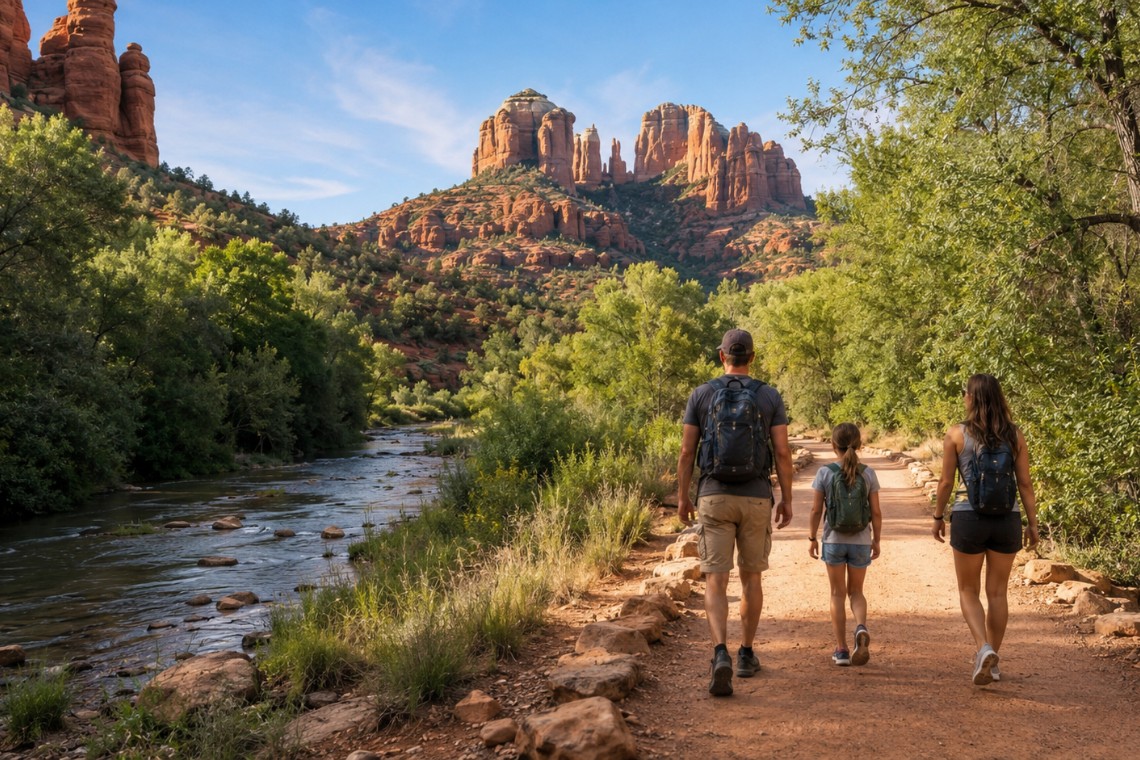
The problem with Red Rock State Park in Sedona, Arizona is entirely its name. It sounds like a generic description of the entire region rather than a specific destination. People arrive expecting to find something they already understand. What they find instead is a riparian ecosystem that is unlike anything else accessible on foot in the Verde Valley, a hawk watch platform that draws serious birders from across the Southwest during migration, ranger-led nature programs that cover material most independent hikers miss entirely, and 286 acres of protected Oak Creek corridor where the Arizona sycamores grow to sizes that visitors from anywhere else in Sedona simply have not seen.
Most people drive right past the entrance because the free trailheads outside the park boundary are a few hundred yards farther down the road. This is a consistent mistake. The park does something that the trailheads do not: it introduces the full ecological complexity of the Sedona landscape rather than delivering one dramatic formation view.
Where Red Rock State Park Is and How to Get There
Red Rock State Park is located in the Red Rock Loop area of Sedona, Arizona, approximately 5 miles southwest of Uptown Sedona via Highway 89A and Lower Red Rock Loop Road. From the Y intersection, head south on Highway 89A approximately 1 mile, turn west onto Lower Red Rock Loop Road, and continue approximately 4 miles to the park entrance, which is clearly signed on the south side of the road.
The drive from Uptown Sedona to the park entrance takes approximately 15 to 20 minutes. The Lower Red Rock Loop Road approach passes through the residential Red Rock Loop corridor and provides views of Cathedral Rock from the north before the park entrance. This approach is itself worth noting: the scale of Cathedral Rock from the Red Rock Loop Road angle is different from the Highway 179 approach most visitors use, and it gives a preview of the formation relationships that the park’s trails explore.
Day use fees at Red Rock State Park in Sedona are: $7 per adult, $4 for children ages 7 to 13, free for children under 7. The America the Beautiful federal pass is not accepted at Arizona State Parks. This is a frequent point of confusion. Admission is paid at the visitor center, not at a trailhead kiosk.
What the Park Actually Contains
Red Rock State Park in Sedona, Arizona protects a stretch of Oak Creek and the surrounding red rock and riparian landscape that is ecologically distinct from the high desert terrain that characterizes most Sedona visitor experience. The park contains 5 miles of maintained trails organized as interconnected loops that pass through several distinct habitat types.
The riparian corridor along Oak Creek within the park supports the largest Arizona sycamore trees accessible anywhere in the Sedona area. These trees grow to canopy heights of 50 to 60 feet in the creek corridor, creating a green tunnel along the water that is visually dramatic in any season and extraordinary in fall when the leaves turn. The sycamore trunks have a mottled, camouflage-pattern bark that makes them recognizable even in winter.
Above the creek corridor, the park transitions through transitional scrub into the red rock terrain that provides elevated views of Cathedral Rock from multiple angles. The Eagles Nest trail at the north end of the park system climbs to an overlook that delivers one of the best Cathedral Rock views available from public land on the north and west faces of the formation. The view is different from the famous reflection photograph at Buddha Beach: it is a direct, elevated perspective that shows the full height of the formation against the sky.
The hawk watch platform is the specific reason that serious birders from across the Southwest visit Red Rock State Park in Sedona during fall migration. Located at the park’s highest accessible point, the platform provides views south along the Verde Valley migration corridor. During the primary migration windows in late September and October, raptors moving south can be counted in the hundreds on a good day, including broad-winged hawks, sharp-shinned hawks, Cooper’s hawks, American kestrels, and occasionally peregrine falcons. The Verde Valley is a recognized migration funnel in Arizona, and Red Rock State Park sits at its northern mouth.
The Visitor Center and Ranger Programs
The visitor center at Red Rock State Park in Sedona, Arizona contains rotating natural history exhibits covering the geology, flora, and fauna of the Oak Creek corridor and the broader Verde Valley. The exhibits cover material that most independent hikers and visitors do not encounter: the formation history of the Schnebly Hill sandstone and the Supai Group below it, the ecology of the riparian corridor and why it supports species that are absent from the surrounding high desert, and the cultural history of the Oak Creek area from the Sinaguan people through the Anglo homestead period.
Ranger-led nature walks occur on weekend mornings and occasionally on weekday mornings depending on seasonal staffing. These walks cover approximately 1 to 2 miles over one to two hours and consistently include material that self-guided trail use does not access: plant identification, animal tracking, geological interpretation, and bird identification that goes substantially beyond what most visitors discover independently.
For first-time Sedona visitors who want to understand the landscape before they engage with it through hiking and formation visits, the ranger program at Red Rock State Park provides context that changes how everything else in Sedona looks.
Why Red Rock State Park Works Differently Than the Trailheads
The free trailheads adjacent to Red Rock State Park in Sedona, Arizona deliver formation views and trail access without the admission fee. Many visitors make a rational decision to use those trailheads instead. What they miss is the ecological depth of the park experience.
Standing at Bell Rock provides a view of one formation from one angle. Hiking Boynton Canyon provides a 6-mile canyon experience. Both are legitimate and rewarding. Red Rock State Park provides something complementary: it explains what Sedona is made of. The riparian corridor, the formation geology, the wildlife habitat relationships, the cultural layers, these are the elements that the park makes legible in a way that the trailhead-focused visitor experience does not.
After a morning at Red Rock State Park, the formations you see from other trailheads later in the day make more sense. The relationship between the creek, the cottonwoods and sycamores, and the sandstone becomes visible rather than incidental. This is the specific value that the park delivers that its entrance fee is worth for the visitor who is doing more than checking off a list.
Red Rock Loop Properties and State Park Adjacency
Red Rock State Park in Sedona, Arizona protects land that borders some residential properties along the Lower Red Rock Loop Road corridor. Properties in this area have a specific benefit that is not replicated elsewhere in Sedona: permanent protected land on one or more sides that cannot be developed. For buyers who value the privacy, view protection, and wildlife access that come from National Forest or state park adjacency, Red Rock Loop properties near the park boundary represent a small and infrequently available inventory category.
Angelo Davis, REALTOR® at RE/MAX Sedona, has worked with buyers specifically seeking protected land adjacency as a primary criterion and understands which Red Rock Loop addresses deliver that characteristic most directly.
Frequently Asked Questions
What is Red Rock State Park in Sedona, Arizona?
Red Rock State Park is a 286-acre Arizona State Park in Sedona’s Red Rock Loop area that protects a riparian corridor along Oak Creek including Arizona sycamore groves, red rock terrain, and diverse wildlife habitat. The park contains 5 miles of maintained trails, a visitor center with natural history exhibits, a hawk watch platform used during fall raptor migration, and weekend ranger-led nature walks.
How much does Red Rock State Park in Sedona cost?
Red Rock State Park in Sedona, Arizona charges $7 per adult and $4 for children ages 7 to 13. Children under 7 are free. The America the Beautiful federal annual pass is not accepted at Arizona State Parks. Fees are paid at the visitor center on entry.
Is Red Rock State Park worth visiting in Sedona?
Red Rock State Park in Sedona, Arizona is particularly worth visiting for birders (especially during fall raptor migration in late September and October), families with children who benefit from the visitor center exhibits and ranger programs, and visitors who want an ecological and geological introduction to the Sedona landscape rather than a single dramatic trail destination. The park provides context that changes how the rest of Sedona looks.
Are dogs allowed at Red Rock State Park Sedona?
Dogs are not permitted on the trails at Red Rock State Park in Sedona, Arizona. Dogs are permitted in the parking lot and picnic areas on a leash. This is an Arizona State Parks policy that protects the wildlife and riparian habitat within the park boundary.
What birds can I see at Red Rock State Park in Sedona?
Red Rock State Park in Sedona, Arizona has a resident bird population including great blue herons, belted kingfishers, zone-tailed hawks, and black-throated gray warblers along the Oak Creek corridor. During fall migration from late September through October, the hawk watch platform provides views of migrating raptors including broad-winged hawks, sharp-shinned hawks, Cooper’s hawks, and American kestrels moving south through the Verde Valley migration corridor.
How long are the trails at Red Rock State Park Sedona?
Red Rock State Park in Sedona, Arizona has approximately 5 miles of maintained trails organized as interconnected loops. The Smoke Trail loop provides the most direct creek and riparian access. The Eagles Nest trail climbs to an elevated viewpoint with Cathedral Rock views. The full trail network can be explored in 2 to 3 hours at a moderate pace with stops.
—
If you are considering properties in the Red Rock Loop corridor and want to understand what protected land adjacency looks like as a daily living experience, explore Red Rock Loop real estate to see what is currently available.
