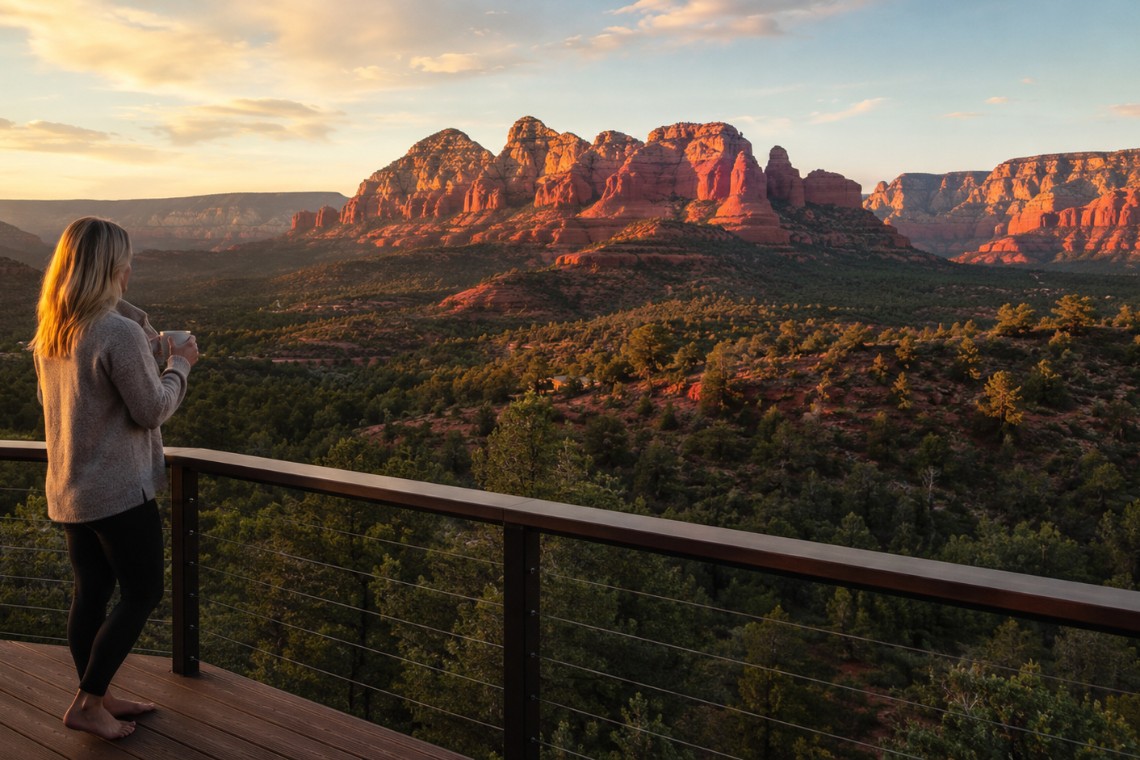
Here is the question luxury buyers almost never ask until it is too late: who, exactly, guarantees that nothing will ever rise between your patio and Cathedral Rock?
In Sedona, Arizona, the honest answer is layered. Some protections are strong, some are conditional, and one common assumption is simply wrong.
This guide explains what actually protects a Sedona view, what does not, and how careful buyers underwrite the difference before paying a view premium.
Does Arizona Law Protect a Homeowner’s View?
Arizona law generally does not grant homeowners an automatic right to their view, meaning a neighbor’s lawful construction can change a sightline without legal remedy. View protection in Sedona, Arizona comes instead from zoning, height limits, CC&Rs, and permanent open land.
This surprises buyers from communities with view ordinances. The default rule is that you own your parcel, not the air over your neighbor’s.
The good news is that Sedona’s protective layers are unusually strong. They just need to be verified per property rather than assumed.
What City Rules Help Protect Sedona Views?
The City of Sedona enforces building height limits, hillside development standards, and design review that significantly constrain what can be built and how tall. These rules protect the community’s overall viewshed, though they do not guarantee any single home’s specific sightline.
Sedona’s height limits are famously conservative, part of why the skyline belongs to the rocks rather than the buildings.
Hillside and grading standards add another layer, limiting how aggressively slopes can be developed. The combined effect keeps most established views stable.
What Offers the Strongest View Protection in Sedona?
The strongest view protection in Sedona is permanent open land, meaning national forest or wilderness boundary behind the sightline, followed by recorded CC&Rs with explicit view provisions in some subdivisions. A view across protected forest cannot be built out.
This is why forest-boundary lots carry their premium. The Coconino National Forest does not subdivide.
Some HOA communities add recorded view corridor provisions or height restrictions among neighbors. Where they exist, they are enforceable contracts, and their exact language matters.
Our guide to Sedona’s best view neighborhoods maps where these conditions cluster, and our forest-boundary guide covers that gold standard in depth.
How Should Buyers Underwrite a View Before Paying for It?
Buyers should identify every parcel in the sightline, check its zoning and development potential, review CC&Rs for view provisions, and confirm whether the backdrop is private land or permanent forest. The analysis takes days, and the premium it protects lasts decades.
Angelo Davis, REALTOR® at RE/MAX Sedona, runs this exercise on every view property his buyers pursue. The question is always the same: what is the worst thing that could lawfully be built in this frame?
Often the answer is comforting. A vacant parcel in the sightline may be unbuildable, already constrained, or priced into the deal as a future buffer purchase.
When it is not comforting, that knowledge is negotiating power. A view with exposure prices differently than a view with a guarantee.
What This Means if You’re Buying a View Home in Sedona
Pay the premium for protected views with confidence, and discount exposed ones honestly. In Sedona, Arizona, the difference between the two is knowable before you sign.
Ask specifically about vacant neighboring parcels, because the empty lot below the patio is either the best or worst part of the deal.
And remember the reciprocal rule. The same height and hillside standards that limit your neighbor also limit you, a trade most view owners happily accept.
Frequently Asked Questions
Can my neighbor build and block my view in Sedona?
A neighbor in Sedona can lawfully build within zoning and height limits even if it affects your view, since Arizona grants no automatic view right. Protection comes from the rules constraining what they can build.
What are Sedona’s building height limits?
Sedona enforces conservative building height limits through its development code, generally keeping structures low to protect community viewsheds. Specific limits vary by zone, and the city confirms them per parcel.
Do HOA rules protect views in Sedona subdivisions?
Some Sedona subdivisions include recorded CC&R provisions addressing views, heights, or roof ridgelines among neighbors. Where present, these are enforceable, and buyers should read the exact language during escrow.
Is a view across national forest land safe from development?
A view across Coconino National Forest or designated wilderness is effectively permanent, since that land is not available for private development. Forest-boundary sightlines are Sedona’s strongest view guarantee.
How do I research a vacant lot in my sightline?
Research a vacant lot through county parcel records, city zoning maps, and the city’s planning department, which reveal ownership, zoning, and development constraints. Your agent can assemble this picture during due diligence.
Do protected views increase Sedona home values?
Protected views command durable premiums in Sedona because their scarcity cannot be diluted by future construction. Exposed views still carry value but price with a discount for uncertainty.
A view is either a fact or a hope, and the records tell you which. If the view is the reason you are buying, let’s make sure it stays yours.
