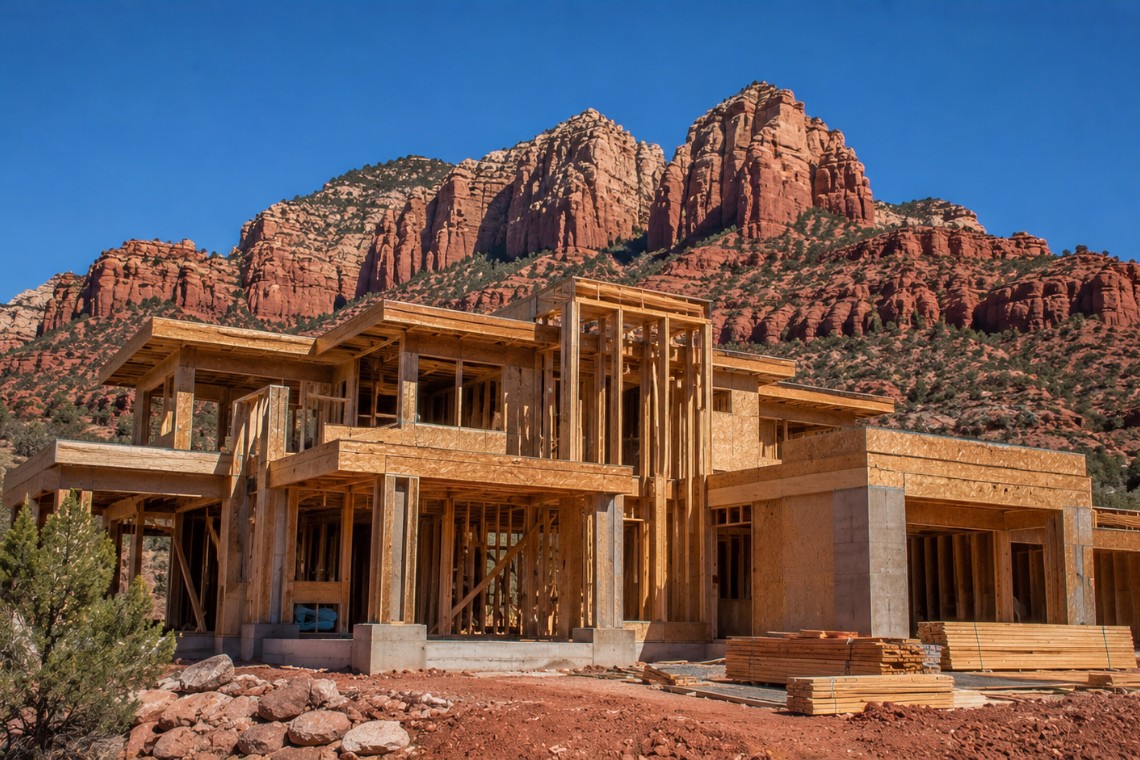
A buyer from Colorado comes to Sedona excited about the possibility of building their custom dream home. They’ve spent six months designing with an architect, imagining their modern masterpiece on a Sedona hillside. Then they learn there are no single-family home lots immediately available, the ones that are available are $1.2 million to $2 million before construction, and the permitting timeline alone is eighteen months. Their vision doesn’t vanish, but it transforms into a different kind of reality.
New construction in Sedona is fundamentally different from new construction in expanding suburban markets. There’s no subdivisions being platted. There are no production builders constructing dozens of homes each year. Most “new” construction in Sedona is actually custom builds on infill lots, meaning someone owned a smaller home or vacant land, it sold to a builder or owner-builder, and a new structure was designed and built on that site. The process is highly individualized, expensive, and constrained by Sedona’s geography and regulatory environment.
Understanding how new construction works in Sedona is essential if you’re considering building rather than buying existing.
The Geography of New Construction in Sedona
Sedona is surrounded by National Forest (roughly 90% of the land within the immediate Sedona area). The state of Arizona holds significant parcels. The result is that buildable private land is scarce. Most lots that become available for new construction are inside Sedona’s town boundaries and are either infill (replacing or rebuilding on existing residential lots) or were historically held by families or investors who are now developing them.
The scarcity is genuine. Unlike Phoenix or Scottsdale, where developers are constantly acquiring raw land and platting subdivisions, Sedona’s available land inventory is relatively fixed. When a lot becomes available, particularly a well-positioned lot with good views or access to trails, it generates significant interest and typically commands a premium price.
This scarcity supports values. But it also means that new construction in Sedona happens lot-by-lot, property-by-property. You won’t find a 150-home master-planned community. You’ll find a developer or individual acquiring a 0.75-acre lot and commissioning a custom build. Another builder might acquire a 2-acre infill property and develop it into two homes. That’s the scale of new construction here.
The Building Process: Permits, Approvals, and Constraints
Building in Sedona requires approval from multiple jurisdictions. The City of Sedona has building codes, design guidelines, and architectural standards. If the property is in Yavapai County (just outside town boundaries), you’re dealing with county permitting. Both entities care about design compatibility, view corridors, and environmental impact.
The design review process is thorough. Sedona’s Design Review Board examines every new construction project. They’re evaluating whether the structure is compatible with the character of Sedona, whether it respects view corridors from public areas, and whether the design language aligns with the community aesthetic. This isn’t a rubber stamp. Designs are regularly requested to revise, scale down, adjust materials, or reposition structures. The process adds time, but it’s also what preserves Sedona’s visual character.
Environmental and geological considerations matter significantly. Sedona is on a hillside. Many potential building sites have slope constraints, elevation changes, or geological features that require specialized engineering. Retaining walls, foundation systems, and grading work are more complex than in a flat suburban lot. Building on a Sedona lot often costs more than identical construction on flat land.
Utilities can be a constraint. While most Sedona lots have access to town water and sewer, some don’t. If a lot requires a septic system instead of municipal sewer, that adds cost and design complexity. If a lot requires a well instead of town water, you’re adding more infrastructure and more permitting.
The permitting timeline in Sedona is not short. From design through final approval, the process typically takes twelve to eighteen months, sometimes longer if revisions are required. Construction, depending on the size and complexity of the home, typically runs two to four years. If you’re imagining breaking ground six months from now, the timeline in Sedona doesn’t accommodate that pace.
Cost Considerations: The Sedona Premium
Building a new custom home in Sedona costs more than building in Phoenix, Flagstaff, or most Arizona markets. There are multiple reasons. First, lots are expensive. A 1-acre buildable lot in North Scottsdale might cost $600,000 to $1 million. A comparable lot in Sedona with good views or proximity to trails might cost $1.5 million to $3 million. That’s the starting point, before construction.
Construction costs are also higher. Skilled labor in Sedona is expensive. Specialized builders who understand Sedona’s design and permitting requirements charge a premium. Materials costs, delivery, and logistical complexity are greater in Sedona’s canyon geography.
Design and engineering costs are higher. An architect in Sedona familiar with the design review process and local nuances is more expensive than an architect in a more routine market. Structural engineering for hillside sites is more complex.
The result is that total project cost for a custom Sedona home is often 30% to 50% higher than an equivalent home built in a more conventional market. If you’re budgeting $3 million to build a luxury home, you might achieve it in Sedona, but it will require careful design choices and experienced local builders. If you’re imagining a sprawling 10,000-square-foot compound, your actual project cost could easily exceed $4 million to $5 million.
Advantages of New Construction
Despite the constraints and costs, building new in Sedona has substantial advantages. The most obvious is customization. You’re not buying someone else’s floor plan, paint colors, or furniture choices. You’re starting from your requirements and building precisely what you want.
Energy efficiency is another advantage. A new Sedona home built to current standards will have superior insulation, modern HVAC systems, efficient windows, and smart home integration. Older Sedona homes, even beautiful ones, often have efficiency challenges. If you’re planning to spend significant time in Arizona’s heat, energy efficiency matters.
Modern systems mean fewer surprises. A new electrical system has capacity for your actual needs. Plumbing, fixtures, and water heating are contemporary. Roof systems are covered by manufacturer warranties. Older homes, even well-maintained ones, carry the unknown future costs of aging systems.
The emotional satisfaction of building new is real. You’ve designed the home. You’ve selected the finishes. You’ve watched it rise from the land. That connection to place is meaningful for some buyers.
The Challenge: Buying Land to Build
The biggest hurdle in building new in Sedona is finding the right lot. If you’re committed to building, the lot is your first priority. A good lot with buildable potential, reasonable slope, good access, and visibility can make or break your project.
Finding those lots requires patience and local knowledge. A real estate agent who understands Sedona’s available land inventory, permitting environment, and what makes a lot genuinely buildable is essential. Someone might show you a lot that’s technically available but has serious constraints that will make building prohibitively expensive or complicated.
Once you’ve identified a lot you’re interested in, you’ll need a surveyor and a geotechnical engineer to evaluate it. What does the slope look like? Is septic feasible, or will you need municipal sewer? Are there view corridors that will limit building height or placement? Are there environmental restrictions? A professional evaluation costs $3,000 to $8,000, but it prevents you from acquiring a lot with hidden complications.
Custom Builders and Architects in Sedona
Working with an architect and builder who understand Sedona’s environment is crucial. Some builders are generalists who work across Arizona. Others specialize in Sedona and understand the design review board, the permitting nuances, the local material preferences, and the view corridor constraints. That specialization is valuable.
A few builders in Sedona have built dozens of custom homes and have relationships with engineers, designers, and material suppliers who understand Sedona. These builders are experienced with the cost and timeline implications of building here. They’re worth the premium you’ll pay.
Architects matter equally. An architect experienced with Sedona’s Design Review Board understands what designs are likely to be approved and what designs will face significant revision requests. They know the material palette that works in Sedona and can design within permitting constraints from the beginning.
When to Build vs. When to Buy Existing
If you have a specific vision of a home that doesn’t exist in Sedona’s current inventory, building may be worth the cost and timeline investment. If you love the idea of a modern architecture with passive solar design optimized for Sedona’s climate, new construction delivers that.
If you’re hoping to move to Sedona and occupy a home within a year or two, buying existing is your only practical option. If you’re willing to invest two to four years in building, and you have a clear design vision, custom building can be rewarding.
If budget is constrained, buying existing is typically more efficient. A $2.5 million budget builds a nice custom home in Sedona, but you might find an existing luxury home with greater square footage and more mature landscaping at the same price point.
If you’re looking for community living with shared amenities, some Sedona subdivisions offer this. Most are smaller and more intimate than suburban subdivisions, but they do exist.
Key Questions Before You Commit to a Lot
Is this lot buildable under Sedona’s current codes and design guidelines?
Get a professional survey and geotechnical evaluation. Don’t assume a lot is buildable just because it’s listed for sale. Some parcels have constraints that make building extremely expensive or technically unfeasible.
What is the actual timeline if I build here?
Permitting in Sedona takes time. Design review takes time. If you have a specific move-in date, make sure the building timeline aligns with that requirement.
Have I connected with a builder experienced in Sedona specifically?
Generic builders can work in Sedona, but builders experienced with the design review process and Sedona’s permitting environment will move faster and make fewer mistakes. The premium you pay for experience saves time and money.
What are my long-term plans for this home?
If you’re building in Sedona, you’re investing in a very specific market. Will this be your primary residence? A second home? An investment property? Your vision for the property should align with your long-term plans.
If you’re seriously exploring building a new home in Sedona, the first step is finding the right lot and evaluating its buildability. That’s where experience in Sedona’s market matters most. Contact Angelo Davis if you’re exploring new construction or evaluating lots in Sedona. Understanding the constraints and opportunities before you commit to a property is critical.
