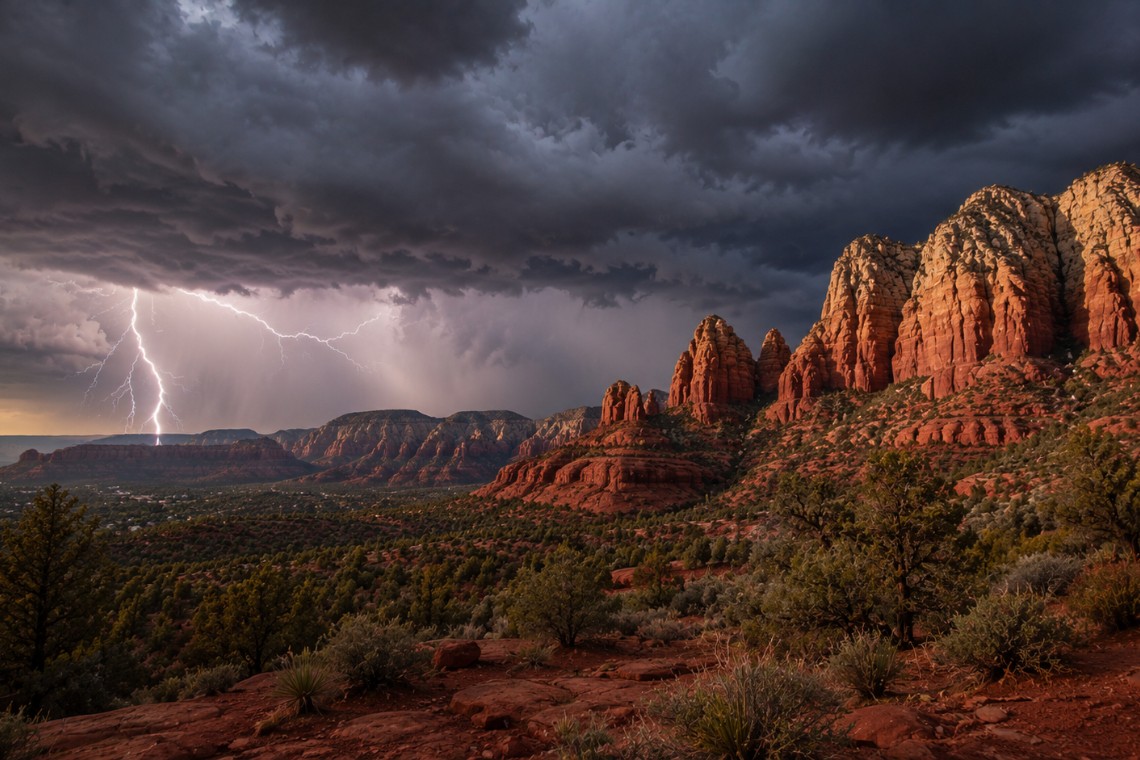
Most people hear the word “monsoon” and picture sheets of rain hammering tropical coastlines for weeks. But in Sedona, monsoon season is something entirely different—and something that catches first-time residents off guard. It arrives in July, peaks in August, and vanishes by September, arriving not as a sustained downpour but as spectacular afternoon thunderstorms that roll across the red rocks with the kind of drama you’d see in a Western film.
If you’re moving to Sedona or considering it, monsoon season is the one meteorological event you need to understand before you sign a lease or buy a home.
What Monsoon Season Actually Is in Arizona
Here’s the counterintuitive part: Sedona doesn’t get rainier during monsoon season in the way you might think. What happens instead is a shift in atmospheric patterns that draws moisture up from the Pacific and the Gulf of Mexico. The result is intense afternoon and evening thunderstorms that dump water fast, create wind gusts that can topple trees, and then leave—sometimes within an hour.
The technical monsoon period runs June through September, but July, August, and early September are when it matters for daily life. You’ll see clear mornings, building heat through midday, and then towering cumulus clouds that stack up like mountains in the afternoon sky. If a storm forms over or near Sedona, it can dump an inch or more of rain in thirty minutes.
This is not the gentle, all-day rain of the Pacific Northwest or the Midwest. It’s a specific weather event that Arizona has adapted to for centuries.
The Beauty and the Danger
The visual spectacle of monsoon season in Sedona is genuinely world-class. Red rocks against dark storm clouds, lightning branching across purple skies, and the kind of light that happens right after the rain clears—this is what photographers chase. If you follow any Sedona Instagram account during August, you’ll see shots that look almost unreal.
But monsoon season also carries real hazards that residents need to take seriously. Flash flooding is the primary concern, especially in washes and low-lying areas. Several of Sedona’s most beautiful hiking areas—places like Cathedral Rock, Devil’s Bridge, and spots in Oak Creek Canyon—become dangerous during storms because water can rise with almost no warning. Every summer, hikers get caught out, and every summer, some of them need rescue.
If you own property, monsoon damage is a real consideration. Roof leaks are common if gutters aren’t maintained properly. Landscaping can be destroyed by wind. Water can run toward foundations if drainage isn’t set up correctly. Flash flood zones exist in Sedona, and if your home is in one, insurance and maintenance costs rise.
Living Through Monsoon Season—Daily Life
For residents, monsoon season means adjusting expectations and routines. You plan outdoor activities for mornings, knowing that afternoons are unpredictable. You check weather forecasts religiously because a storm that seems far away can develop and arrive within hours. You pull your car into a garage if you have one, because hail is possible.
Traffic can become treacherous during storms. Visibility drops, pavement gets slick, and drivers who aren’t used to monsoon behavior make mistakes. If you work in the Verde Valley and commute from Sedona, you learn to respect afternoon traffic jams that form when storms move through SR-89A.
At the same time, longtime Sedona residents—and there’s something specific about people who choose to stay through multiple monsoon seasons—will tell you they actually love it. The smell of rain on hot red rock, called “creosote,” is unique to desert monsoons and genuinely magical. It’s distinct enough that longtime residents notice it immediately when they travel back to Sedona after being away. The cooling effect is profound. After a 110-degree day, a monsoon storm can drop temperatures twenty degrees in minutes. There’s a collective exhale across the town.
What Monsoon Means for Hiking and Outdoor Activities
Sedona’s trail system is one of the main reasons people move here or visit. During monsoon season, that changes dramatically. Many trails become off-limits during or immediately after storms because water runs off the red rocks into washes with almost no time to slow down. People hiking in those areas can be caught between walls with rising water and no way out.
The standard monsoon-season advice is simple: don’t hike in washes, don’t hike after storms until trails dry out, and don’t be caught on trails when storms approach. This means planning hikes for early morning, watching the sky constantly, and being willing to turn back. Some residents avoid outdoor hiking entirely during peak monsoon weeks and shift to other activities instead.
Road conditions matter too. Oak Creek Canyon—the scenic drive from Flagstaff to Sedona—can become dangerous during heavy runoff. Small washes cross the road, and flash flooding has closed the road before. If you’re commuting or planning a drive during monsoon season, timing matters.
Property Considerations—What Buyers and Owners Should Know
When you’re evaluating a home in Sedona, monsoon season should factor into your thinking. Is the property in a designated flash flood zone? Does it sit in a natural drainage path? Has the roof been inspected recently? Are gutters and downspouts properly maintained? Does landscaping include deep-rooted trees and native plants that can withstand wind, or shallow ornamental plants that will topple?
These aren’t deal-breakers—most of Sedona’s homes were built to handle monsoon season—but they’re factors. Homes in canyon locations or in arroyos carry different considerations than homes on ridge lines. Properties with mature, well-maintained landscaping and proper drainage manage monsoon season better than neglected ones.
If you’re buying in Sedona and monsoon season is new to you, ask your real estate agent about the property’s drainage, its location relative to washes, and whether the current owner has had any flood or wind damage. This isn’t routine due diligence—it’s specific to Sedona’s climate and matters.
Why Longtime Residents Talk About Monsoon Season Like It’s a Character
After a few monsoon seasons, Sedona residents stop seeing it as a weather threat and start seeing it as a seasonal personality trait. It’s the one time of year when the climate doesn’t feel perfectly controlled. It’s when nature shows up with power. It’s also when the town slows down—tourists thin out, locals reclaim restaurants and trails, and there’s a collective understanding that afternoon storms might change plans.
Many people who move to Sedona from the Midwest or Pacific Northwest are surprised by how much they miss actual weather—variation, unpredictability, storms with presence. Monsoon season delivers that. It’s not a deal-breaker; for many people, it becomes a reason they stay.
If you’re considering a move to Sedona, monsoon season is worth experiencing before you commit. If you’re shopping for a home, understanding how monsoon season works—its risks, its beauty, and its rhythms—helps you understand the place you’re moving into. It’s not something to fear, but it’s something to respect and understand.
Sedona is a climate of extremes tempered by elevation. Monsoon season is when that truth becomes most visible.
Share this with someone planning their first Sedona summer and wondering what to expect. Browse current Sedona listings and reach out when you’re ready to explore neighborhoods and properties.
