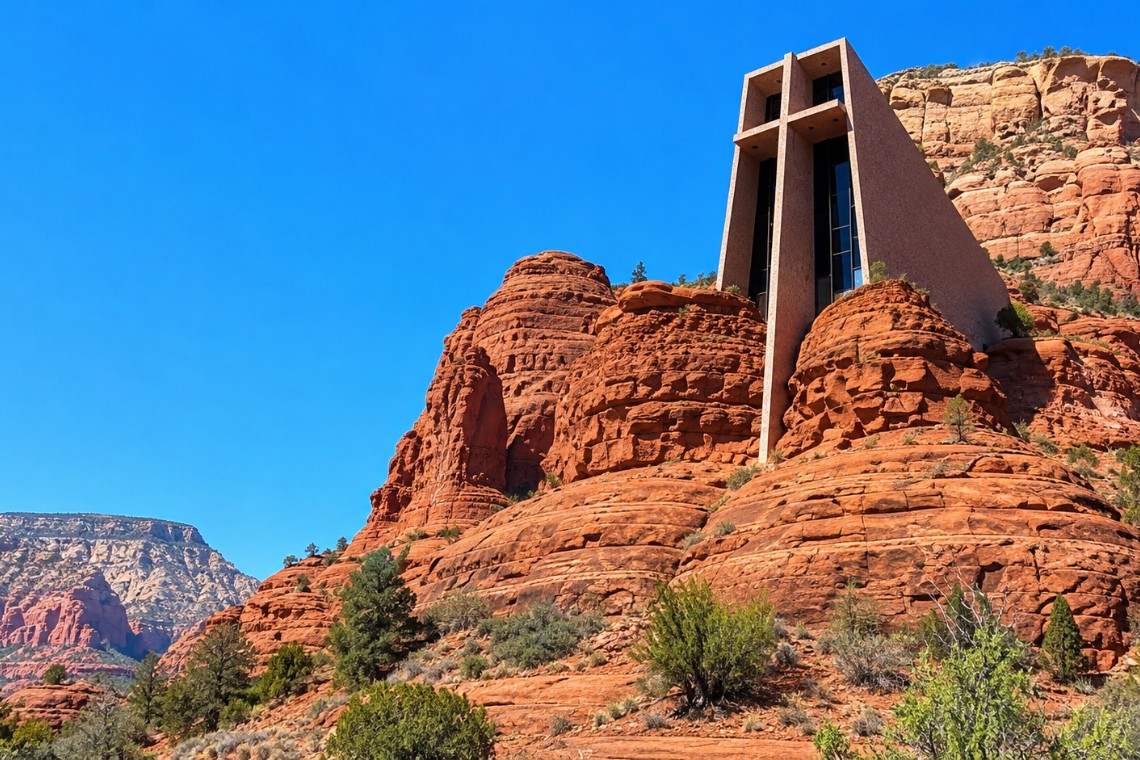
In 1932, a rancher named Marguerite Brunswig Staude was in New York when she saw the construction progress on the Empire State Building and had a vision. She wrote to Frank Lloyd Wright describing a chapel she wanted to build someday, one that would rise from rock rather than stand on it, one that would use the cross as both spiritual symbol and structural element. Wright sketched a concept. The vision found its site twenty years later on a red rock formation in Sedona, Arizona that Staude recognized from a photograph taken by her brother-in-law.
The chapel that opened in 1956 is exactly what the original vision described: two concrete towers rising directly from the sandstone, a cross spanning the full facade between them, floor-to-ceiling glass behind the altar looking south across the red rock landscape. It was named one of Arizona’s Seven Wonders within a decade of opening. It draws more than 500,000 visitors per year. Most of them spend less than twenty minutes.
The Architectural Story: What Makes It Work
The Chapel of the Holy Cross was designed by architect August K. Strotz in collaboration with Staude, working from the visual logic Wright had established in their earlier correspondence. The building was not designed to stand apart from the landscape. It was designed to emerge from it. This distinction is the key to understanding why it succeeds architecturally when so many similar efforts fail.
The concrete is deliberately rough-textured and mixed with local aggregate that gives it a color approaching the surrounding sandstone. The towers rise 90 feet above the chapel floor. From the approach road below, the cross appears to grow from the rock rather than to have been placed upon it. This is the effect Staude described in her original letter to Wright: a structure that belonged to the geology it occupied.
The site selection was specific and deliberate. The formation that supports the chapel faces southwest, providing the light angles that make the building most dramatic at golden hour. The elevation above the Chapel Road below, approximately 250 feet, provides the vertical separation that makes the formation-building relationship readable from the valley floor. Staude’s brother-in-law’s photograph that led her to the site captured this relationship, and the building was designed to enhance rather than compete with the rock.
The Interior: What Most Visitors Discover
The interior of the Chapel of the Holy Cross in Sedona, Arizona is small by almost any measurement. Seating capacity is approximately 50 people. The nave is narrow. The ceiling is low relative to the exterior towers. The scale reinforces the intimacy that the architect intended.
What the interior provides that the exterior does not is the full Cathedral Rock view through the floor-to-ceiling south-facing windows behind the altar. From inside the chapel, Cathedral Rock and Bell Rock are both visible through the glass, the red rock formations serving as the backdrop to the altar in a way that is startling the first time you see it. The art in the interior is minimal: a bronze sculpture of Christ at the center of the altar, a few smaller pieces in the nave. The restraint is intentional. The view is the visual anchor, not the art.
The chapel is an active Roman Catholic place of worship. Masses are held on Sundays. During services the building is not open to general visitors. Outside of service times, the chapel is open for quiet prayer, meditation, and visitation. The practice of visiting the chapel in contemplative silence rather than as a photo stop is what the majority of the building’s long-term visitors describe as the experience that stayed with them.
The Approach Road and Why It Matters
The road that climbs from Highway 179 to the Chapel of the Holy Cross in Sedona, Arizona was not designed as mere infrastructure. The switchbacks provide a deliberate viewing sequence of the building against the formation. Each turn reveals a different composition of the chapel and the rock. The approach is part of the architectural experience in a way that is unusual for a destination accessed by car.
The parking lot at the top of Chapel Road holds approximately 30 vehicles. This is a severe constraint for a destination that receives more than half a million annual visitors. On spring and fall weekend afternoons, the lot fills completely and cars queue down Chapel Road waiting for spaces. The overflow condition is genuinely congested. Arriving between 7 and 8:30 AM on any day of the week virtually eliminates the parking problem. Arriving after 10 AM on a spring or fall weekend creates it.
The approach via the Bell Rock Pathway trail from the Village of Oak Creek is an alternative that a small fraction of visitors use. The trail approach adds approximately 1 mile of walking from the Village of Oak Creek direction and eliminates the parking problem entirely while providing the additional reward of the red rock formation walk leading to the chapel.
The Light and When to Visit
Photographers who have spent time at the Chapel of the Holy Cross in Sedona, Arizona consistently identify two prime windows. The first is the two hours before sunset, when the low western sun catches both the concrete of the chapel and the sandstone of the formation at similar angles, creating a warm, unified color across the combined structure. This is the window that produces the most commonly reproduced exterior photographs.
The second window is early morning, when the chapel face is in partial shadow and the Cathedral Rock view through the south windows is illuminated by the rising eastern sun. This window is less documented photographically but delivers a fundamentally different interior experience. The chapel at 7:30 AM on a Tuesday in November, with the morning light filling the south windows and no other visitors present, is the experience that many long-term Sedona residents consider the most valuable version of what the chapel offers.
Summer midday visits are the least rewarding. The chapel face is in full sun and loses the texture that shadow angle provides. The parking situation is its worst of the day. The interior is warm. The combination of heat and crowds compresses the experience into something shorter and more transactional than the building warrants.
Chapel Area Real Estate and This Landmark
The Chapel of the Holy Cross sits at the northern end of the Chapel Area neighborhood in Sedona, Arizona, near the Gallery Row and Hillside Sedona corridor. Properties in the upper sections of the Chapel Area, particularly those at elevation on the formation-facing hillsides, have sight lines toward the chapel structure itself as part of their view. This is a specific premium within the Chapel Area market that distinguishes certain properties from others in the neighborhood.
The daily traffic pattern on Chapel Road, which serves both the chapel and the residential neighborhoods behind it, is a practical consideration for buyers. Spring and fall weekend afternoons create queuing on Chapel Road. Weekday traffic is minimal. Buyers evaluating properties accessed via Chapel Road should drive it on a weekend afternoon in shoulder season before committing. Angelo Davis, REALTOR® at RE/MAX Sedona, can walk any buyer through the Chapel Area’s traffic realities alongside its genuine view and lifestyle advantages.
Frequently Asked Questions
Is the Chapel of the Holy Cross free to visit in Sedona?
Yes. The Chapel of the Holy Cross in Sedona, Arizona is free to visit. There is no admission fee. Parking is limited to approximately 30 vehicles and fills quickly on spring and fall weekends. The chapel is open daily from 9 AM to 5 PM, though hours may change during services and private events.
Who built the Chapel of the Holy Cross in Sedona?
The Chapel of the Holy Cross in Sedona, Arizona was commissioned by Marguerite Brunswig Staude, a rancher and sculptor who first conceived the project in 1932 after corresponding with Frank Lloyd Wright. The chapel was designed by architect August K. Strotz and completed in 1956. It was named one of Arizona’s Seven Wonders and has drawn more than 500,000 annual visitors since opening.
Can you attend Mass at the Chapel of the Holy Cross in Sedona?
The Chapel of the Holy Cross in Sedona, Arizona is an active Roman Catholic chapel that holds regular Sunday Mass and services for special occasions. Mass schedule and service times are available through the Diocese of Phoenix. The chapel is open for quiet prayer and visitation to all visitors outside of scheduled service times.
How high up is the Chapel of the Holy Cross in Sedona?
The Chapel of the Holy Cross in Sedona, Arizona sits approximately 250 feet above Chapel Road on the red rock formation that serves as its foundation. The concrete towers rise 90 feet above the chapel floor. The site was chosen specifically for this elevation, which makes the building visible and legible from the valley below and provides the south-facing Cathedral Rock view through the interior windows.
How far is the Chapel of the Holy Cross from Uptown Sedona?
The Chapel of the Holy Cross is approximately 3 miles south of Uptown Sedona, Arizona on Highway 179 and Chapel Road. The drive takes approximately 8 to 10 minutes from the Y intersection. The chapel is also accessible by foot via the Bell Rock Pathway trail from the Village of Oak Creek direction, adding approximately 1 mile of walking from that approach.
What is the best time to visit the Chapel of the Holy Cross in Sedona?
Early morning visits between 7 and 9 AM provide the best combination of available parking, light quality on the formation, and minimal visitor traffic at the Chapel of the Holy Cross in Sedona, Arizona. The two hours before sunset provide the most dramatic exterior photography conditions. Spring and fall weekend afternoons from 11 AM to 4 PM have the worst combination of parking congestion and direct overhead light.
—
The Chapel Area is one of Sedona’s most distinctive neighborhoods because landmarks like this one anchor its identity. Explore Chapel Area real estate to see what is currently available in this neighborhood.
