Most real estate markets are governed by the standard value trinity: location, condition, and price.
Sedona, Arizona has all three. But it also has four factors that operate at a level of specificity that doesn’t exist in most markets — factors that explain why two homes on the same street can differ in value by hundreds of thousands of dollars.
Factor 1: View Quality and Protection
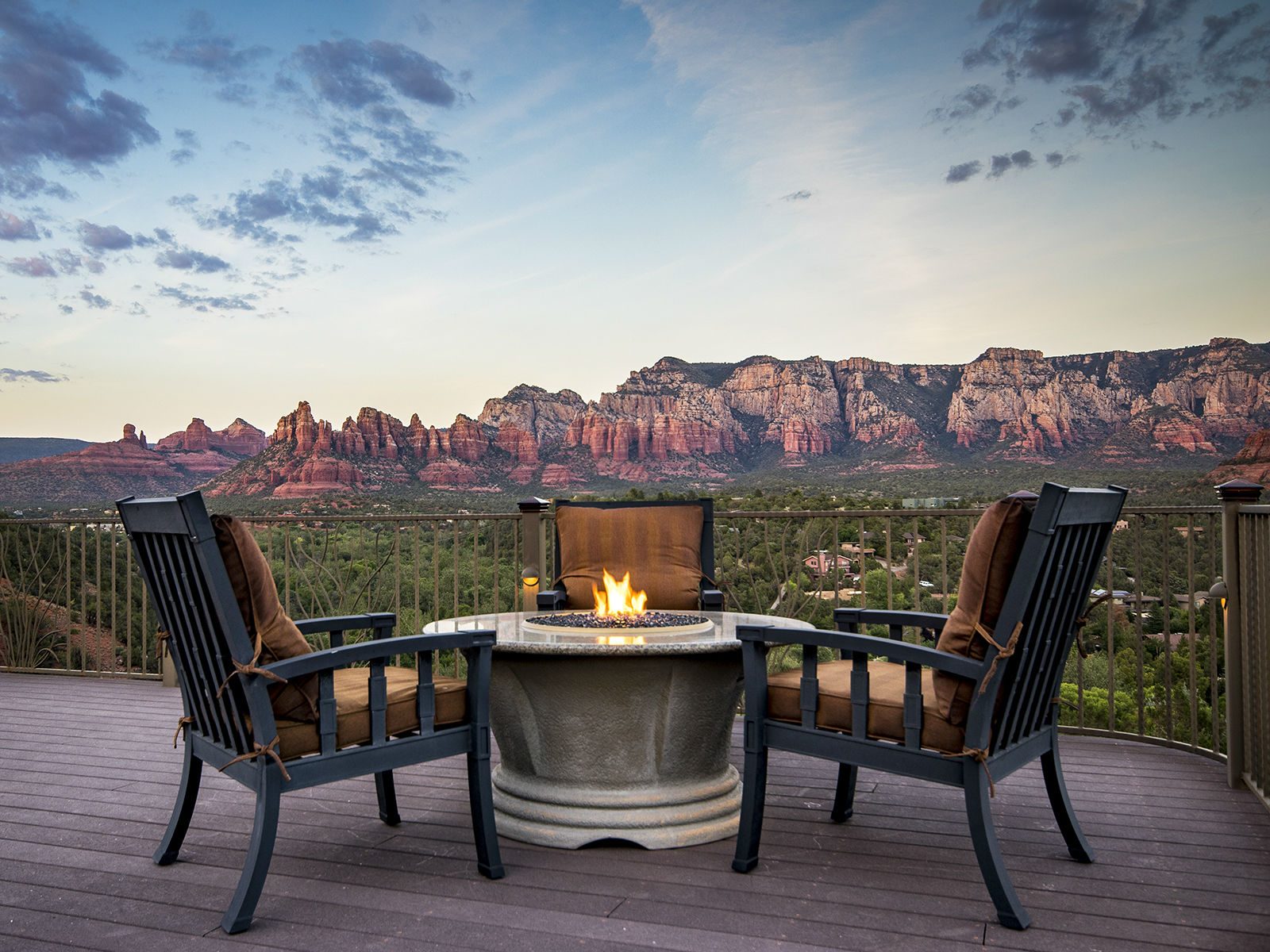
View is the dominant value driver in Sedona. Not just whether a home has a red rock view, but which formation, from which rooms, with what orientation, and whether that view is permanently protected.
A direct, unobstructed view of Cathedral Rock from the main living areas is worth more than a partial view of a lesser formation from a secondary room. That’s not a preference — it’s a measurable price differential of $200,000 to $500,000 or more between otherwise similar homes in the same neighborhood.
The protection factor matters separately. A view of Cathedral Rock that faces National Forest land cannot be blocked by future development. A view that faces an undeveloped private parcel could be compromised if that parcel is eventually built on. The permanent view versus the potentially temporary view trade at different prices, even when they look identical at the time of purchase.
Read the full guide to Sedona’s best red rock views here.
Factor 2: Single-Level vs. Multi-Level
This factor consistently surprises buyers and sellers from markets where it doesn’t apply.
In Sedona, Arizona, a significant portion of the buyer pool is 55 or older. Retirees, semi-retirees, and buyers planning for long-term primary or second home use consistently prioritize single-level living. The ability to live entirely on one floor is not just a preference for many Sedona buyers. It’s a requirement.
A single-level home and a comparable multi-level home in the same Sedona neighborhood will price differently. The single-level commands a premium, typically in the range of 10% to 20% depending on the specific market segment and neighborhood.
For sellers of single-level properties, this premium should be reflected in pricing. For buyers evaluating multi-level homes at similar prices to single-level comparables, the discount reflects a real market reality.
Factor 3: Lot Size, Privacy, and Setting
Sedona’s topography creates enormous variation in privacy between adjacent properties. A home tucked into a natural rock formation, screened by mature vegetation, and positioned so that no neighboring structure is visible in any direction is a fundamentally different living experience from an equivalent home on a flat, exposed lot two streets away.
In Sedona’s market, this privacy premium is real and consistent. Buyers pay for the feeling of being in the landscape rather than adjacent to it. Large lots with natural screening, homes that back directly to National Forest or BLM land, and properties positioned to capture views while maintaining separation from neighbors all command premiums that square footage and bedroom counts don’t fully explain.
Factor 4: Condition and Maintenance History
Sedona buyers are experienced. They compare your home against everything else in their budget. And they know immediately — not from the inspection, but from the showing — whether a property has been maintained or deferred.
A home where the roof is in good shape, the HVAC systems are maintained and documented, the pool equipment functions properly, and the exterior paint is fresh tells a story about how the property has been cared for. That story reduces buyer anxiety about hidden problems, reduces negotiating friction during the inspection period, and justifies asking price rather than inviting discount.
A home where visible maintenance has been deferred tells the opposite story. Buyers who see chipped paint, aging equipment, and uncorrected issues don’t think “I can negotiate for those repairs.” They think “what else haven’t they fixed?” That doubt has a real cost in both days on market and final price.
How These Four Factors Interact
A Sedona home that has an extraordinary Cathedral Rock view, single-level floor plan, large private lot backing to National Forest, and documented maintenance history is at the top of its market segment. It prices accordingly and sells efficiently.
A Sedona home that has a mediocre view, a two-story floor plan, a flat exposed lot, and deferred maintenance is at the bottom of its segment regardless of square footage. It requires aggressive pricing to generate the same buyer interest that the first home generates naturally.
Understanding where your property sits on each of these four dimensions is the starting point for every pricing and preparation conversation. Angelo Davis, REALTOR® at RE/MAX Sedona, evaluates these four factors specifically in every comparative market analysis he prepares for Sedona sellers.
Frequently Asked Questions: What Affects Sedona Home Values
Why do two similar Sedona homes have such different values?
In Sedona, Arizona, two homes with nearly identical square footage and bedroom counts can differ in value by hundreds of thousands of dollars because the primary value drivers are view quality, single-level versus multi-level floor plan, lot privacy and setting, and condition. These factors require local expertise to evaluate accurately.
How much does lot size affect home value in Sedona?
Lot size matters in Sedona primarily in terms of the privacy, setting, and natural landscape integration it enables rather than raw acreage alone. A small lot positioned to maximize view and privacy can be more valuable than a larger lot with poor view orientation and full exposure to neighboring properties.
Does the age of a Sedona home affect its value?
Age itself is less determinative in Sedona, Arizona than condition and maintenance history. A well-maintained older home with documented systems updates will trade more competitively than a newer home with visible deferred maintenance. Buyers discount for uncertainty about condition more than for age when the property has been demonstrably cared for.
How does National Forest adjacency affect Sedona property values?
National Forest and BLM land adjacency is one of the most consistent value premiums in Sedona’s market. Properties adjacent to protected public land have permanently protected views, no development risk from adjacent parcels, and in many cases direct trail access. This combination is a structural premium that persists through all market conditions.
What home improvements add the most value in Sedona?
The highest-return improvements address the four value factors directly: anything that enhances view exposure, outdoor living improvements that frame the landscape, condition repairs that eliminate buyer doubt, and single-level conversion if applicable. Major interior renovation projects rarely return their full investment at sale in Sedona’s market. Read the full pre-sale improvement guide here.
How do I find out what my specific Sedona home is worth?
A professionally prepared comparative market analysis that accounts for the four Sedona value factors is the most accurate approach. Angelo Davis provides complimentary CMAs for Sedona homeowners with no obligation to list. Request your valuation here or reach out at (928) 274-9114.
“`
—
### META DESCRIPTION
“`
Two Sedona homes on the same street can differ by $500K. Here are the four factors that actually drive home values in Sedona, Arizona — and how to use them.
